
L60xW30xH30mm, China
This is a small stone carving of a small rat and cucumber.
Does rat like cucumber?
L60xW30xH30mm, China
This is a small stone carving of a small rat and cucumber.
Does rat like cucumber?
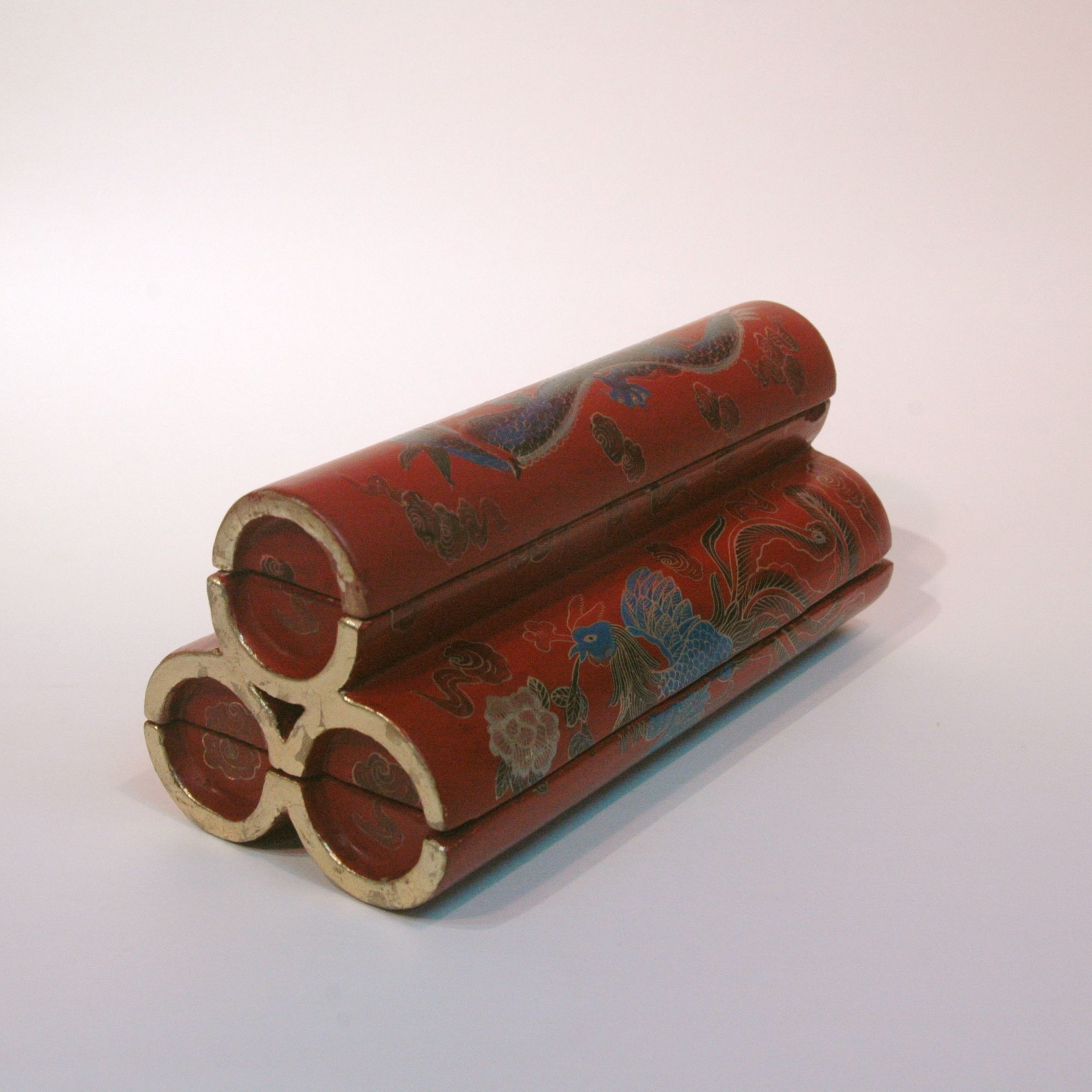

W100xL230xH100mm, China
A lacquer box with painted dragon and phoenix which comes with 2 levels and 3 circular compartments. This is probably a box for storing small incense but our customers found it to be a good idea to use it for storing stationary.
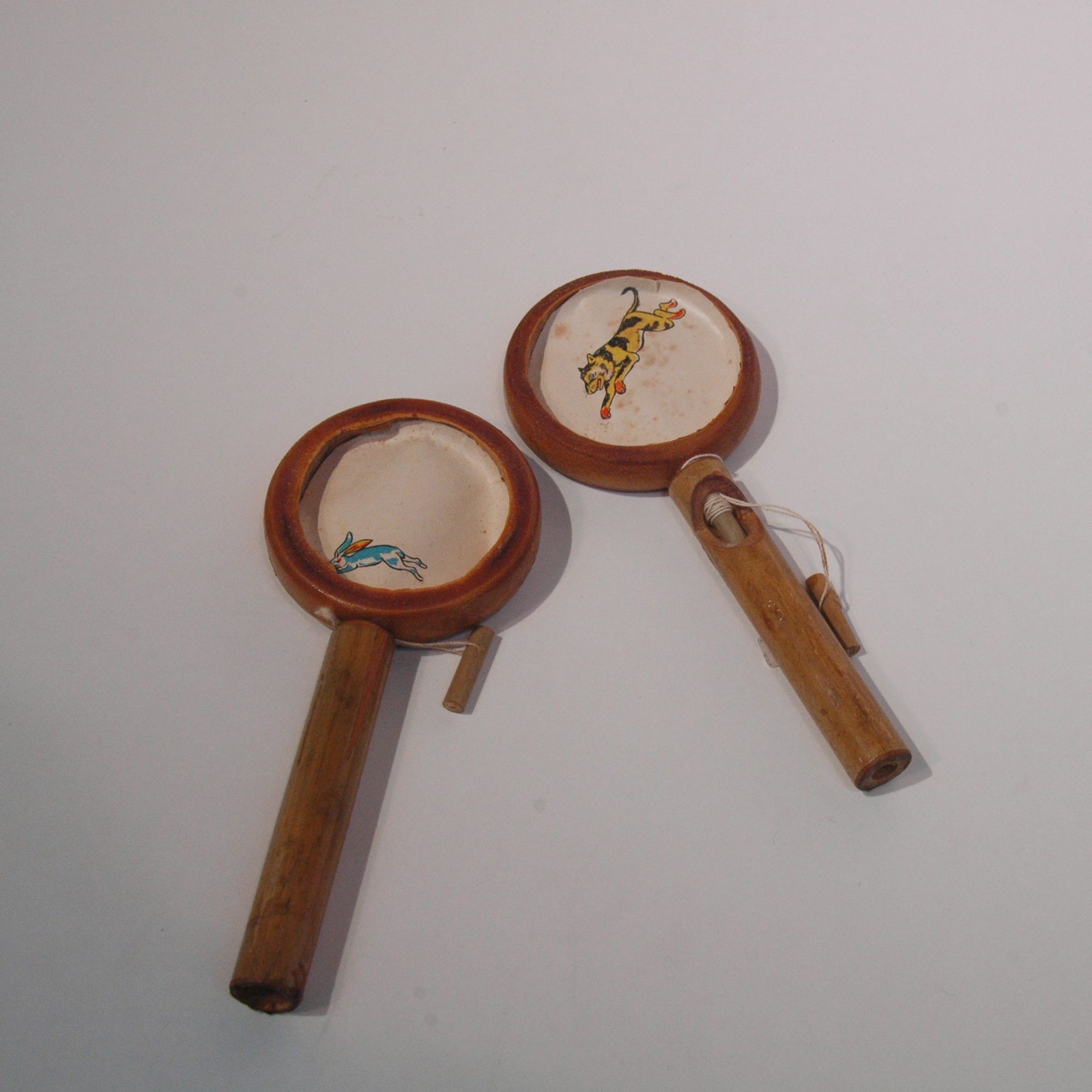 DIA70xL160mm, China
This is a Chinese version of the thaumatrope; by pulling the string that is attached to the axial of the circular frame, the image inside the frame will turn over and over again. The 2 images from both side of the frame will appear as 1 due to the persistence of vision. The momentum of the spin will cause the axial to spin at the reverse direction result in a prolong animation.
click on me!

DIA550xH600mm, China
This small umbrella has a silver handle, a structure is made of bamboo and yawn, the shade is non-waterproof, to top it off, it has 2 pom pom on the top of the cap. This is in fact a Chinese dance umbrella. Around the Sung dynasty, merchants from the northern province acquired the umbrella from the south and brought them home as a novelty, in order to show it off a dance show is invented. The moral of the story is – product promotion started early in China.

W70xL140xH50mm, China
Dont be mislead by the tabloid title, this is in fact a piece of stationary, a copper box for keeping seals and seal paste. In China seal was the form of identification, a bit like the rubber stamp which is officially recognized. The seal of the Emperor would represent the Emperor himself. In the old days, most people will at least own a set of personal seal, but for artist and intellectuals they will own also a leisure set and a studio set, for each set there will be a collection of a seals. There are a long culture for seals; the stone, the text, the design and the craftsmanship are all refined and specialized.

W40xL80xH80mm, China
Clay toys are a popular folk toy, they are affordable and has a certain naive and child like expression. Wonder how these clay toy are made? The clay from 2m under ground are usually used (they are easily available, higher in plasticity and with less impurity). The dug up clay is sun dried then crushed down with a mallet. The fine clay sieved out into a dish and soaked with water for a several days. The semi wet clay is lay on a stone slab; after a sprinkle of water, it is pounced with a mallet, this process is repeated several time until the clay is not sticking to the slab, then form a cube with the clay. Slabs are cut out with a wire and then into coil. The coils are pressed onto a 2 pieces mould (the mould are dusted with dried clay powder for ease of case removal), the 2 parts of the mould are then joined together and joined together with additional coil from the inside, then the bottom is sealed off. The mould is released and the clay toy is left to dried before colouring. The base colour of the Chinese clay toy are normally white, with a few line to pick up the details.

W530xH1020mm, China
This wooden lattice was part a building, these lattices featured in all traditional Chinese buildings, temples, courts, residential house, etc. They are the upper part of the door which is responsible for letting light into the house. Its a kind of a window, you could say. Buildings are measured by the unit of Jian, and for each jian there will be 4 lattice door. The whole door is of the proportion 1:3 or 1:4. The door is divided into 3 parts, the top is the lattice Ge Shan, the middle is Yao Chuan, the lower part is Zhang Shui Ban. The lattice is constructed by joinery and most often with a miter joint. Danial Sheets Dye’s Chinese Lattice Design has a lot of information regarding the Chinese lattice, it was first published in 1937!

W300xH450mm, China
The head, feet and hands of the glove puppet is made of wood and its body and arms in a fabric formed glove. For the right hand control puppet, with the whole hand in the glove, the thumb would go into the left arm of the puppet, the index finger in the head and the remaining 3 fingers in the right arm of the puppet. As the puppet is directly control by the hand, fine mechanism can be built into the head for the control of the eye, the mouth etc. As in all theatre, the characters of the glove puppet show can be classified into 7 category and each with its many subtypes; the Sheng (male role), the Dan (female role), the Jing (the painted face strong character), the Chou (clown), the Xian (saint), the Guai (monster).
The puppet here is of the saint category, Ling Guan, he is a Taoist saint who used to be bad temple god who would eat children for a meal. A powerful wizard tamed him with a flying fire charm and set his eyes on fire. Ling Guan was upset and filed a complaint to the Jade Emperor who compensated him with a golden whip and a third eye of wisdom, he was also allowed to follow wizard and take his revenge if he found the wizard doing a bad deed. 12 years he followed the wizard and the wizard only do good and no wrong, Ling Guan was moved, instead of hoping for his revenge he became a disciple of the wizard.

DIA110xH70mm, China
Today is the 15th day of the Chinese New Year, Yuan Xiao, a day which denotes a lot of events;
– First full moon of the new year
– End of the Chinese New Year celebration
– Chinese valentine’s day
– Lantern’s festival
It is traditional to have a rice dumpling soup on the day and to solve the lantern riddle.
Here is the recipe for the rice dumpling soup (also known as Yuan Xiao)
INGREDIENTS
For the dumpling (make 10 dumpling)
For the soup
LANTERN RIDDLE
Here is a lantern riddle to go with your dumpling soup (now all you need is to find a valentine and a lantern …)
WHEN IT IS SITTING ITS SITTING
WHEN IT IS STANDING ITS SITTING
WHEN IT IS MOVING ITS SITTING
WHEN IT IS SLEEPING ITS SITTING
(guess an animal)
The bowl presented here is in fact a tea bowl (blue and white porcelain with painted goldfish), its a brewing and drinking bowl for individual enjoyment. Hot water is added to the tea leaves in the bowl, rinse and drained (use the lid to retain the tea leave). A second round of hot water is added and brew for 10 minutes. The lid is opened for appreciation of the scent and the colour of the tea, it is then close again with a small small opening. Tea is slowly sipped out from the gap.
(answer to the riddle – frog)

DIA70xH120-250mm, China
We have a collection of these green glazed oil lamps, in pairs, of different heights. For the ceramic oil lamp design, the design for these lamps are the most basic. Its functional, well proportioned and durable (if Muji existed in Qing dynasty China, I suspect their oil lamp will be like these). They are made on a pottery wheel and glazed with green glaze that has been popular since the Sung dynasty.
 Mountain Folkcraft