Archives for category: wood

W120xH650mm, China

Gold and lacquered wood carving is a craft specialized in the Chao Zhou area; lacquer are applied on the wood carving before gold leaf is gilded on.  The carving are used to decorate items from furniture to architecture.  One of the theme for the wood carving are popular legends and scenes from opera.  This particular wood carving tells the story of Hua Mu Lan (made even more popular by Disney in the movie Mulan).  In the Northern dynasty, there were a lot nomad attacks in the north, one male from each family are required to be drafted to war.  The girl Mulan’s family has an elderly father and a very young brother, Mulan decided to take upon the duty, disguised herself as a male and went to join the army.  After a 12 years battle, the war was won and Mulan triumphantly returned, only then did her army mates realized she was in fact a female.

DIA200(up to 400)xH70mm, China

This is a lacquered dish for offering fruits (fresh and dried) for ceremony.  The dish is made in segments and hold together by a piece of wire, with the curvatures on all directions, this is a difficult task to do.  This particular dish is decorated with a gold painted floral painting, some of the dishes are decorated with figures of well known stories.  Unfortunately, these stories are often emperor based, these are forbidden during the cultural revolution, in order to save the lacquered ware, the head of these painted figures would be scrapped out hence the content of the stories removed.

H540xW410xD200mm, China

This is screen is actually classified in history as a stationary, in the Song dynasty it is designed to be used as a screen to shield the inkwell from evaporation.  As time goes on, it became more of a desktop decorative item.  This cha ping has stone painting framed by mahogany.  The painting cleverly made use of the grain of the marble in the composition, at the back is a poem about a snow scene which reflect the marble grain.  The frame is removable, the painting can be taken out easily to show the reverse side.

W200xH300m, China

This is a mask of the Di Xi (Ground Opera); this form of opera is practice by the farmer villages in Gui Zhou area.  The folks will perform the opera passed on by the previous generation on Chinese New Year for around 20 days.  Unlike the other mask dances in China, apart from deterring away the evil spirit, the Di Xi only consist of fighting or war themes.  This specific themes can be explained by the its history; in early Ming dynasty,  tribal attacks along the border and by Mongols from the previous dynasty  has not be settled.  Military base were formed in the Gui Zhou area, these soldiers were known as the fort men (Tunpu), Di Xi was their opera, a way of introducing military and culture into the rural area.  Ceremony will be performed for the blessing of the mask, before the masks are blessed they are appreciated merely as wood carving objects, however once the blessed with prayers and scattered with the blood of a rooster they became sacred. The Di Xi masks are also worn differently from other Nuo masks; performers would covered their head with black muslin and wear the masks on their forehead.  The mask in the photo is General character, the colourful ornament on his head is in fact a helmet.

Come check them out!

W80xL250xH140mm, China

We have cowboys in China too and this is a very famous cowboy.  At the end of the Ming dynasty, a time when the capital was under the attack of revolts, the Qing army, the Ming  capital moved south to Nanjing.  The courageous General Zheng  led the Ming navy defended against the Qing at the north, deterred the pilots from the Netherlands and claimed back Taiwan.  Before his return from Taiwan the Qing army took over the ruling of China and Zheng died unsettled in Taiwan.  When Qing took over, the folks were still reminiscent of the previous dynasty, not knowing Zheng’s death was longing for his return to bring back the Ming empire.  At his hometown Fujian, as a discreet statement, the craftman made variation of sculpture with a cowboy on a screaming buffalo; the first Ming emperor Zhu was in fact the famous cowboy.  Now nearly 400 years on, this design has gained his own name.

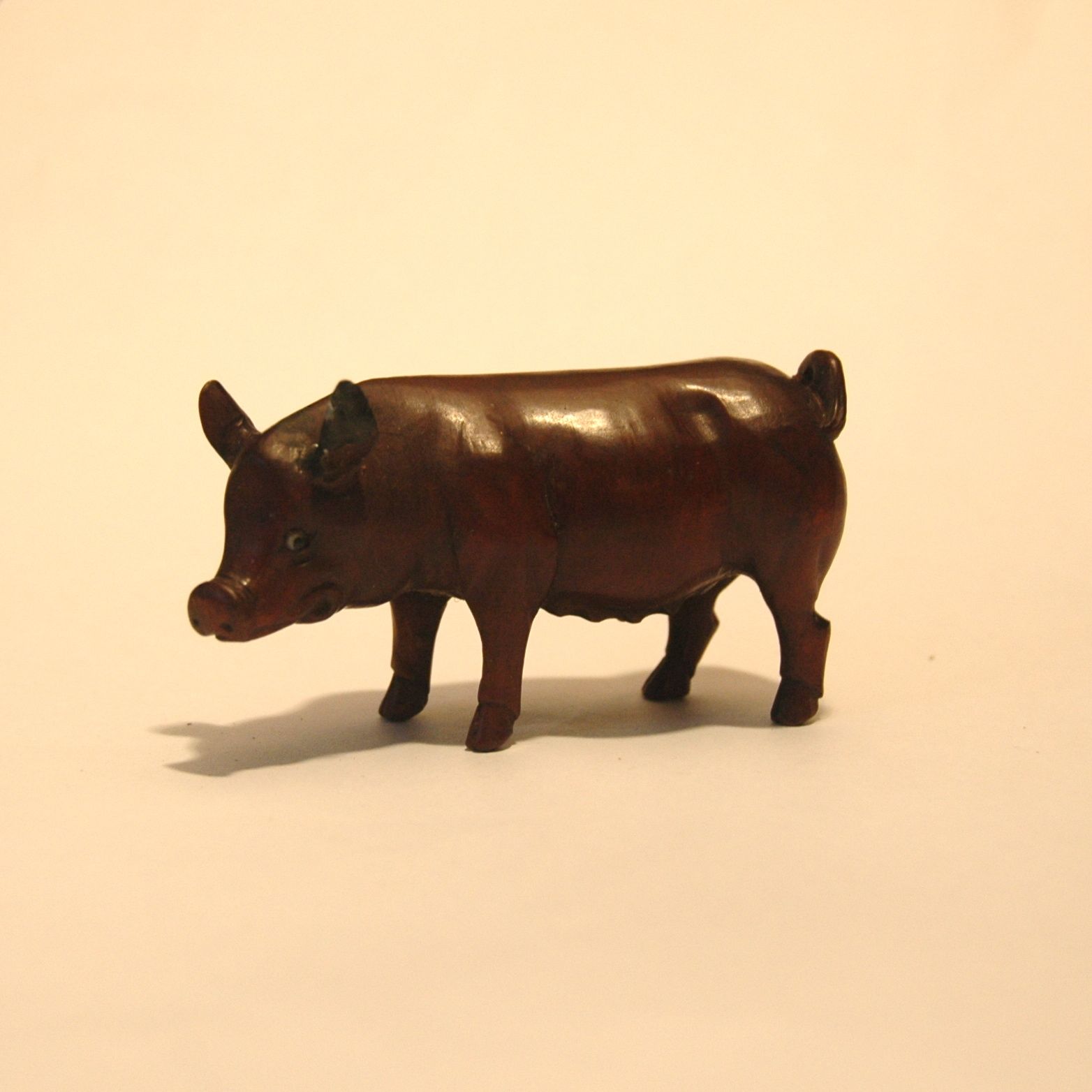
L80xH50mm, China

Sorry piggy, I writing a good roast pork (Char Shui) recipe today;

INGREDIENTS

  • 1 kg boneless pork shoulder
    (the rolled one in supermarket is fine)
  • 2 tbs honey

MARINADE

  • 2 tbs hoisin sauce
  • 2 tbs ground yellow bean sauce
  • 4 tbs thin soya sauce
  • 5 tbs sugar
  • 1 tbs medium dry sherry
  • 2 tbs chinese rose wine
  • 1 tsp salt
  1. Divide the pork into 50mm wide long stripes, leave the fat on
  2. Mix the marinade and marinade for at least 4 hrs
    (turning every 30 mins)
  3. Preheat the oven to 180c, place the strips of pork on a wire rack in the middle of the oven (put a tray of water a the bottom to ease cleaning)
  4. Roast for 30 mins, redip in marinade and roast again for 30 mins
  5. Take out, test that it is cooked, rest on rack, applied honey, sliced up to 10mm thick and enjoyed!

W180xL130xH80mm, India

These are stamps (Bunta) for making woodblock print textile.  Over a piece of draft pattern, the craftsman laboriously chisel out the design from a single block of wood.  Over at the printing sweatshop, plain colour fabric is stretched over the printing table.  The vegetable dye paste is placed in a tray and even out over a sheet of wire.  No draft or guiding sheet is used for the printing, the master printer would set out the outline colour, judging only by his eye, hands, points on the stamp and experience.  The stamp is placed and hit a few times by the fist ensuring a good impression.  The printing would go from left to right.  After the outline colour is finished, the second printer would follow, then the third etc.  The fabric is then put into an acid wash to fix the colour.

W150xL200mm, Malaysia

This is a Mah Meri mask used for the Mayin Jo-oh mask dance ceremony.  The Mah Meri is a tribe of 2000 people living along the southwest coast of West Malaysia.  Mayin Jo-oh is a traditional dance where the Muyang (plant and animal shadowless spirits) would join in the celebration.  The dance is performed by 5 women and 2 masked men in a counter clockwise fashion.

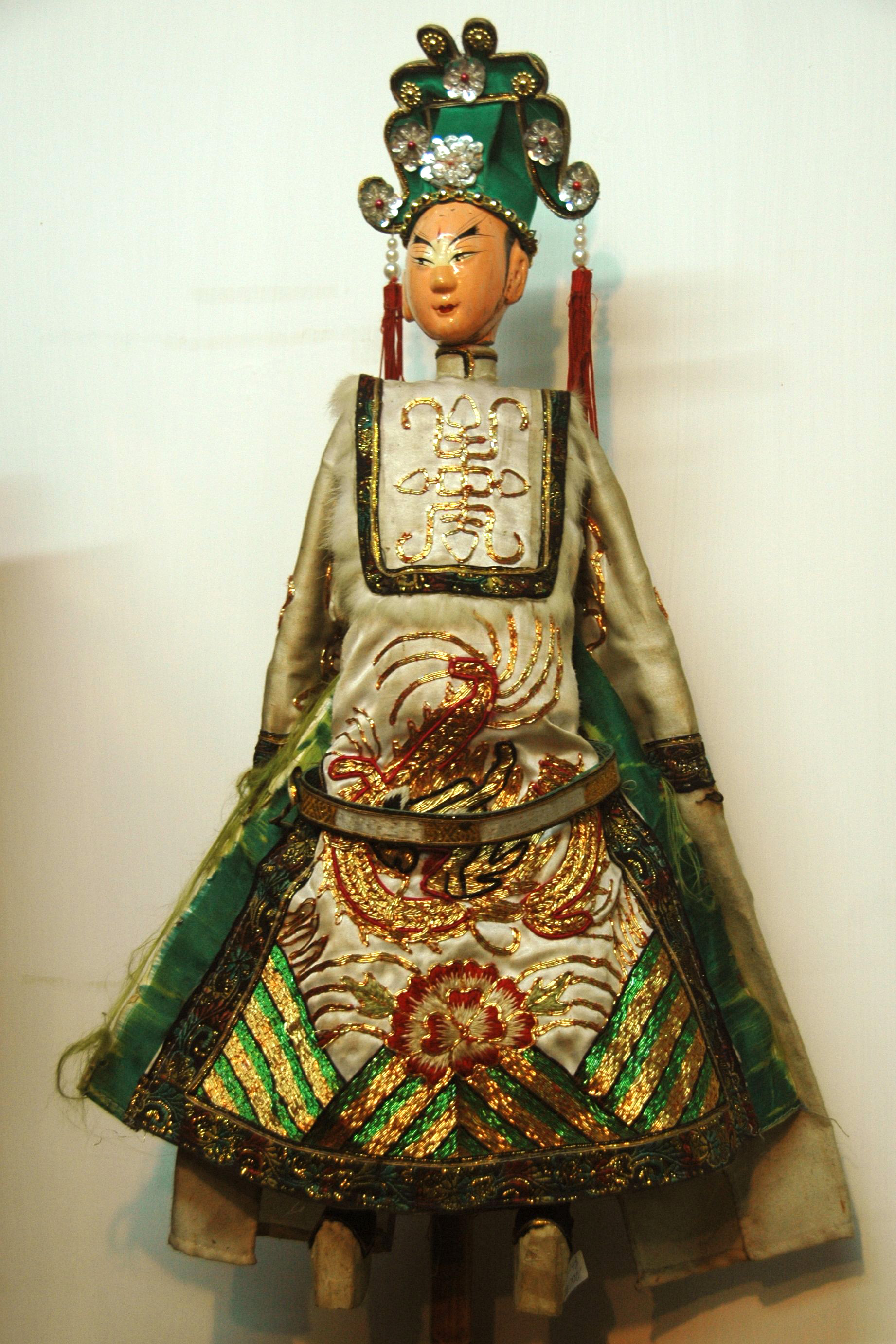
H500xW150mm, China (Chaozhou)

This is a Chaozhou wire puppet.  The head and the body are made by 3 separate specialist craftman, a pottery is charge of the clay head, an embroider is responsible for the costume and the puppet maker for the body, legs, hands and putting the puppet all together.  The body is made with a piece of local soft wood (Erythrina variegata) that has been treated by wetting and drying against cracking and snapping.  The clay head is painted over with the facial characteristic for the different character of the puppet show and these also go for the costume.