Archives for category: stone

pork belly

W55xD60xH60mm, China

Got your appetite ready for the Chinese New Year fest?  Would this slow cook pork belly make your mouth watery?

Fear not for the cholesterol, this is in fact a piece of stone which naturally reassemble the most desirable cut the “5 layers belly” where five thin layers of muscles is sandwiched in between layers of fat.

The most famous pork belly dish in China would have to be the Dong Po Rou, invented by the Sung scholar Su Dong Po.  He was arrived in Huang Zhou as the new governor only to find half of the West Lake was covered with a kind of wild grass, he ordered for the grass to be cleaned up and developed a waterway system that not only prevented flooding but also made use of the water for cultivation.  For the revival of the beautiful West Lake, the residents brought also their precious pork and order them to him.  Su Dong Po accepted all the offerings, but instead of keep them all for himself, he asked his chef to cook the meat with his special recipe and give a piece to every household.  They have never tasted anything so delicious and here it is;

INGREDIENTS

  • 1 piece of pork belly 120x120mm
  • a couple of spring onion, cut half in length
  • few slices of ginger
  • strings
  • 50g sugar
  • 120g Chinese wine or dry sherry
  • 70g light soya sauce
  • water

METHOD

  1. tied the pork belly as if you are putting a ribbon on a present
  2. blanch it quickly in boiling water and take out
  3. in a casserole, put the spring onion and ginger slices at the bottom, then put in the pork skin side down
  4. follow by the sugar, soya sauce and wine, then top up with water, put the lid on.
  5. bring to boil then turn the heat down to the smallest and slow cook for 30 mins then turn the meat over so that the skin faces up and cook for another 30 min.
  6. cut the meat into four piece and serve with a hot bowl of rice.
  7. enjoy!

pork

blue rock  W130xD20xH80mm, China

A curious blue object.

This is no modern art but a carving of the Shou Shan stone.  The blue, without the artistic symbolism of Western art of the sacred, the heaven, the ideal, the escape etc etc was a mean of disguise.  During the cultural revolution, all objects of art and decoration were target to be destroy and its owner punished.  The owner must have treasured this object, instead of destroying it like many art object at the time, a layer of blue paint was applied to escape the prying eyes of the red guards.

Odd at it is, we have kept the blue paint on, as it is part of the history of this object.

OLYMPUS DIGITAL CAMERA OLYMPUS DIGITAL CAMERADIA140mm, China

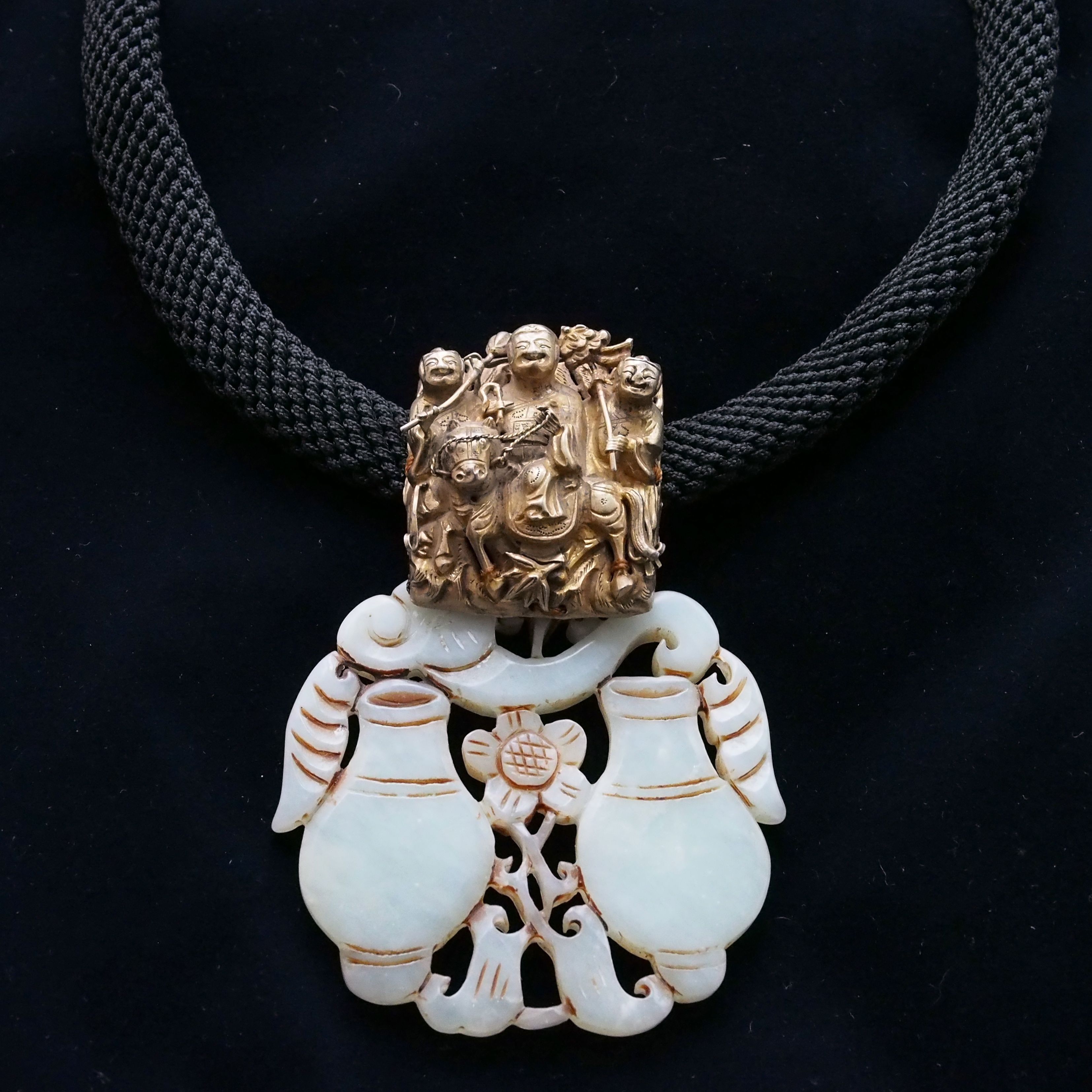
This delicate gold plated carving used to be a hat decoration.  Until the Qing dynasty hat was seen as a status symbol, worn by only the Emperor and the high ranking officials, commoners are forbidden to wear hats and usual tie their hair with a piece of cloth.  It was until the Qing dynasty that hats became an item for all, though their style and details are still well defined by the social levels.  On its hundredth day birthday, a baby would be given a hat which is constructed a bit like the beach ball, bind by 6 equal wedges of cloth.  The 6s represented the sky, the earth and the four directions.  On this hat a decorative ornament would be place over the forehead, an ornament of good wishes; the eight immortals, longevity, luo han, etc.

This particular decoration has the theme of a Zhuang Yuan, the scholar who came top in the examination.
A wish for scholarly, prosperity, loyalty to the country, everything parents would wish for their child.

Something Old Something New
Collectible Jewellery Collection

OLYMPUS DIGITAL CAMERAL400mm, China

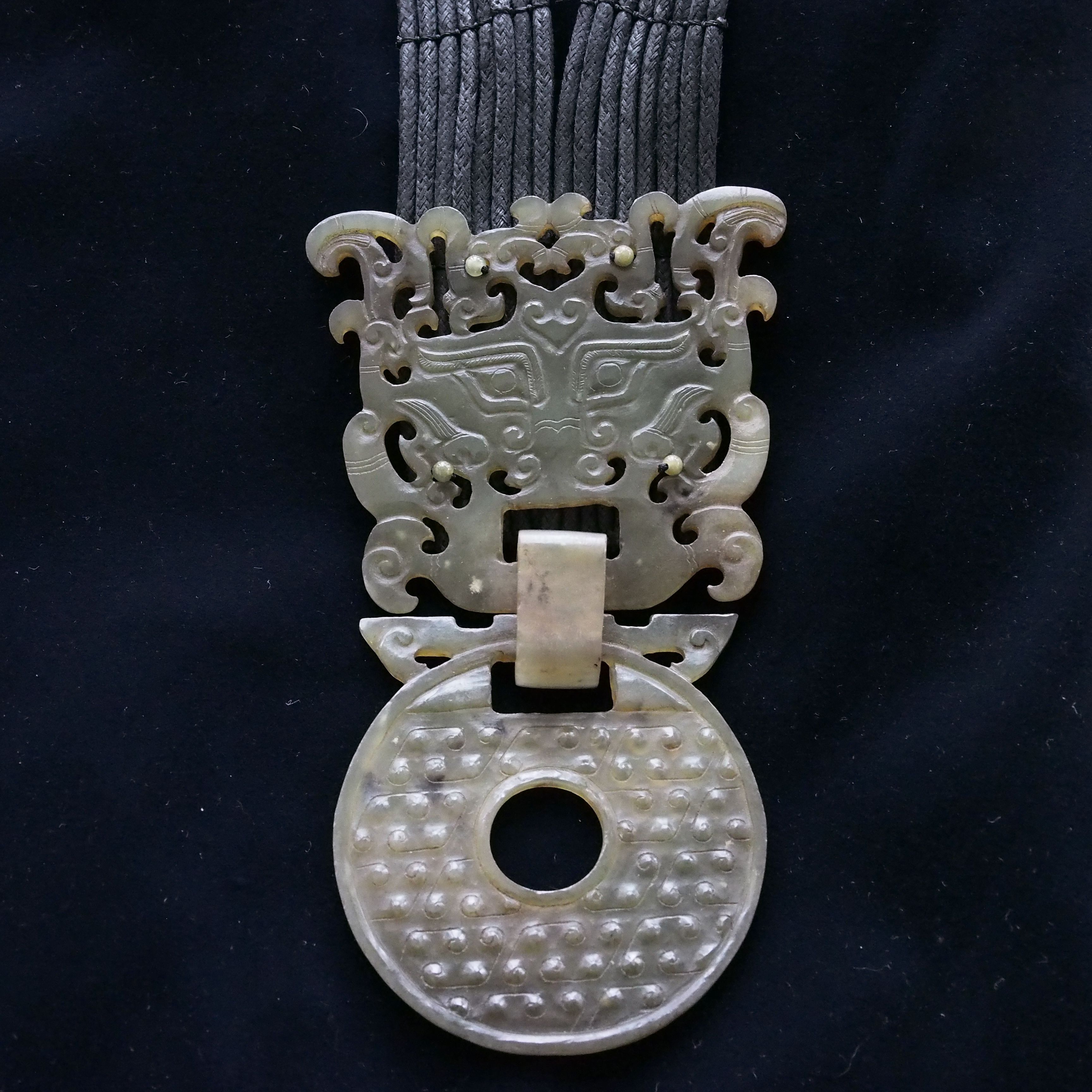
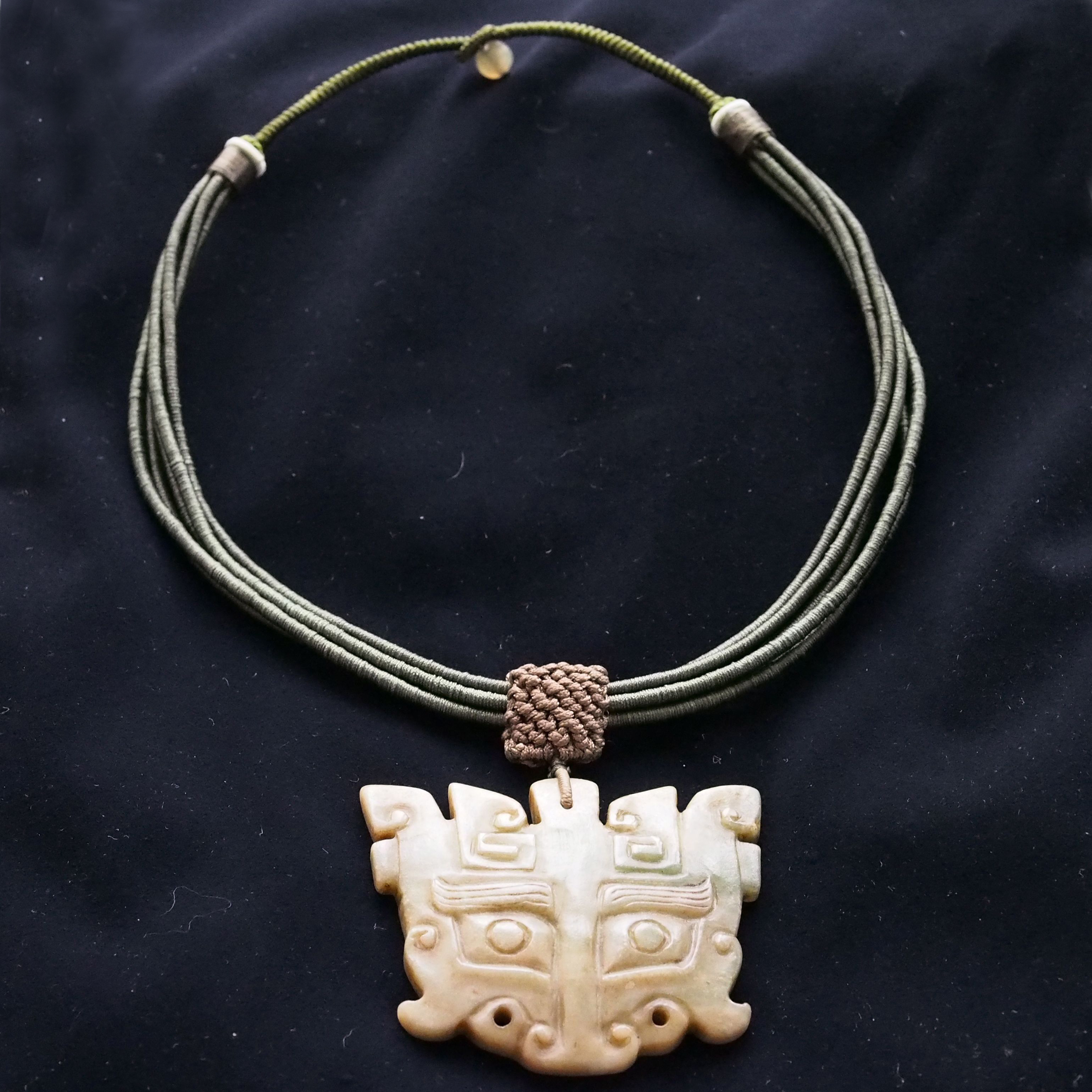
 A beautiful jade carving pendant of a Tao Tie with a yu bi hanging from his mouth.

According to the book Sheng An Wai Ji, the poet Yang Seng, described the nine sons of the dragon, Tao Tie is one of them.  They are;

Bi Xi, one who like carrying heavy stuff and often found with a stone tablet on his back.
Chi Wen, one who enjoys the vista, often found one the ridges of buildings.
Pu Lao, love music, found on bells.
Bi An, one who hates criminals, found on the lintel of the prison.
Tao Tie, one who loves to eat, found on lids and the side of cauldrons; sometimes found on the middle of the beam, it is believed that he can drank all the water and keep the flood away.
Gong Fu, love to play with water, found on bridges.
Ya Zi, a fierce creature with weapons.
Suan Ni, loves smoky fire, found on the lid of incense burner.
Jiao Tu, hates trespassers, oftern found on the main door.

This mythical creature, the fifth son of the dragon, is one who loves to eat made a perfect ornament for festive season.

OLYMPUS DIGITAL CAMERA

Something Old Something New
Collectible Jewellery Collection

OLYMPUS DIGITAL CAMERADIA140mm, China

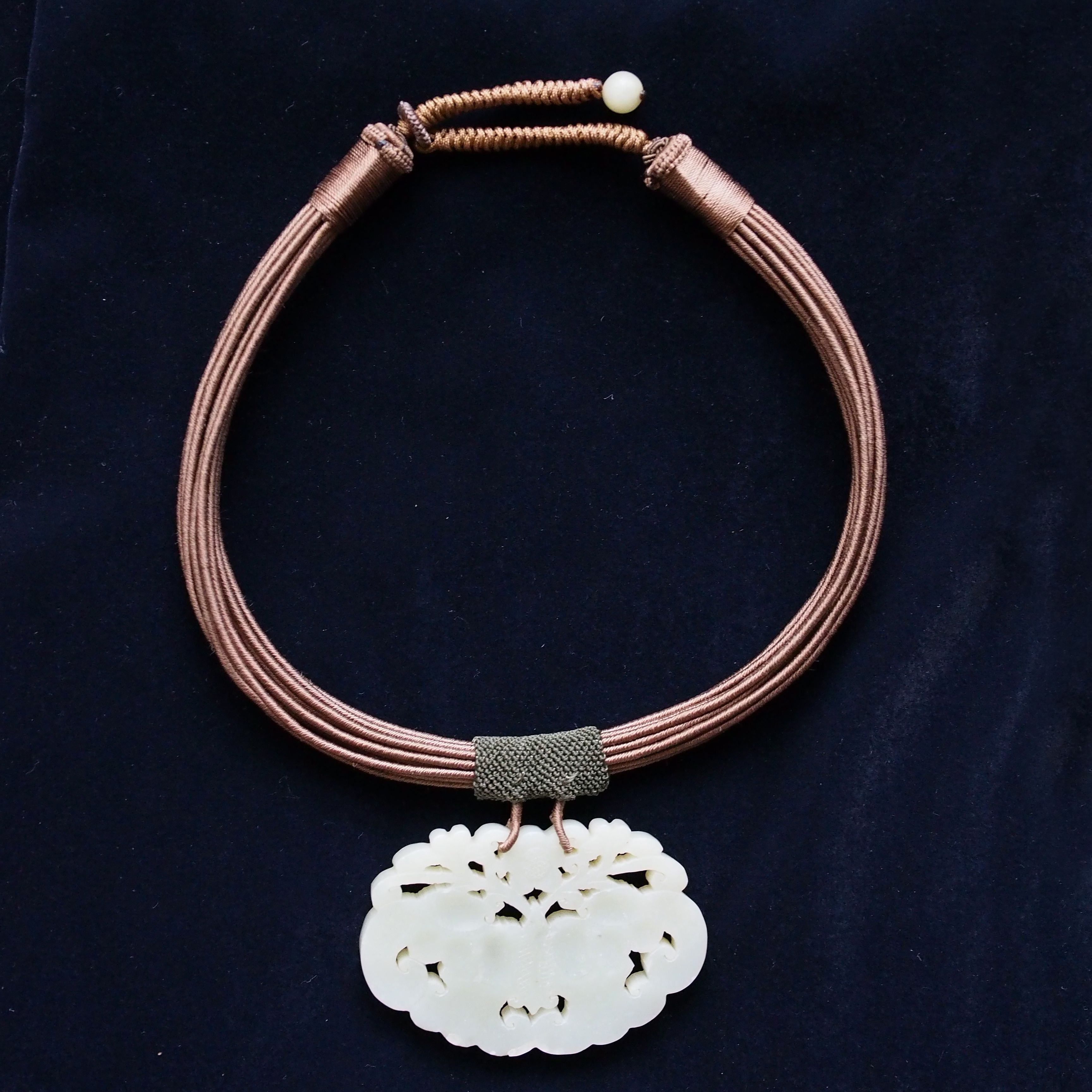
A  hetian jade butterfly pendant on beautifully hand woven necklace.

OLYMPUS DIGITAL CAMERA

Something Old Something New
Collectible Jewellery Collection

OLYMPUS DIGITAL CAMERADIA130mm, China

The pendant is of a different version of the Ye Le Li featured earlier in the blog.  Ye Le Li was used as a status identification object, a decoration that is hang by the waist.

Something Old Something New
Collectible Jewellery Collection

OLYMPUS DIGITAL CAMERADIA120mm, China

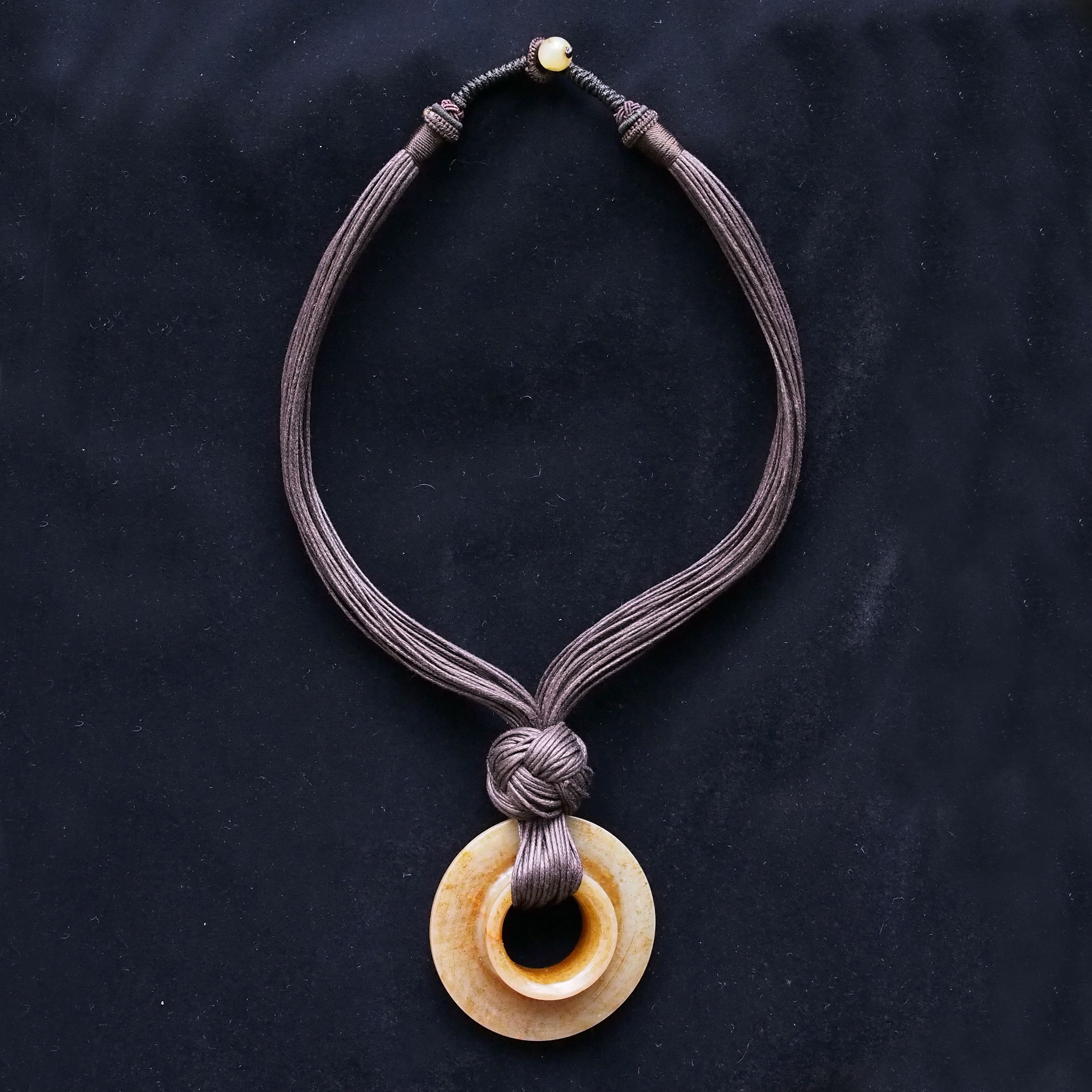
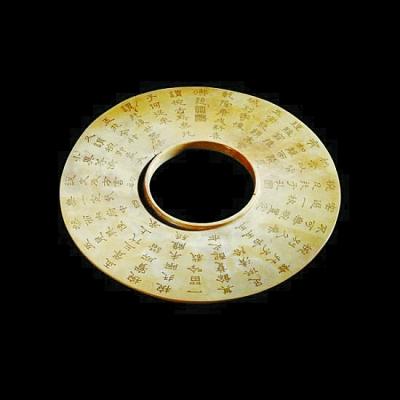
 Yu Bi is a form of jade that is used for ceremony, like the jade huang it is one of the 6 forms of jade that is used for ritual ceremony and later identification.  Yu Bi generally describes a piece of circular jade with a hole in the middle, as they sometimes come with pattern, this particular would be known as a Su (plain) Yu Bi, its being raised up in the center is known as a collar hence You Ling (collar) Su Yu Bi.   This form of Yu Bi was for the late Shang dynasty, like the iphone in the 20th century, it was an high tech object, a status symbol that became so popular that it can be found in various parts of China.

This is Emporer Qian Long’s favourite, he wrote several poems about it and asked for the poem to be engraved onto the jade.  The item is now part of the British Museum Collection.

Something Old Something New
Collectible Jewellery Collection

OLYMPUS DIGITAL CAMERADIA130mm, China

OLYMPUS DIGITAL CAMERA

A pair of jade bats.
The Chinese believes that bats symbolizes blessing, 2 bats, double blessing.
The word for bat is 蝠 ( fu), which sound like the word for blessing, 福 (fu)

Personally, I think they are the sweetest bats, perhaps second to this … wait to see it even yawns!

Something Old Something New
Collectible Jewellery Collection

OLYMPUS DIGITAL CAMERADIA140mm, China

This beautiful necklace is made up of a string of hollowed jade beads.
The colour works strikely well with the hand woven Chinese knots string.

OLYMPUS DIGITAL CAMERA

Something Old Something New
Collectible Jewellery Collection

OLYMPUS DIGITAL CAMERA

DIA140mm, China

The creature of the pendant is known as a “Tao Tie”, in mythical legend he is fifth son of the dragon.  The Tao Tie has the face of a goat and the body of a man, he has eyes under his armpits, teeth of the tiger but the voice of a baby.

The Tao Tie is said to be a greedy eater and thus his images are found in a lot of bronze cauldrons, even the gourmet experts are referred to as old Tao.

Something Old Something New
Collectible Jewellery Collection