Archives for category: paper

W400xH250mm, China

The folding fan was introduced to China from Japan in the Song dynasty; they were a gift from monk Chonen to the Emperor.  Emperor Zhu Di lead on the fan fashion, he ordered the court to produce a large number of hand fans, decorated with poems or verses and award the to the high officials.  This became to the trend of the intellectuals, exchanging poems and calligraphy through the fans as a gesture of friendship.  Even the Qing dynasty, the fashion of hand fan was well in its height.  This is a fan from the 50s, a Bai Ju Yi poem about parenthood was added by my father recently.

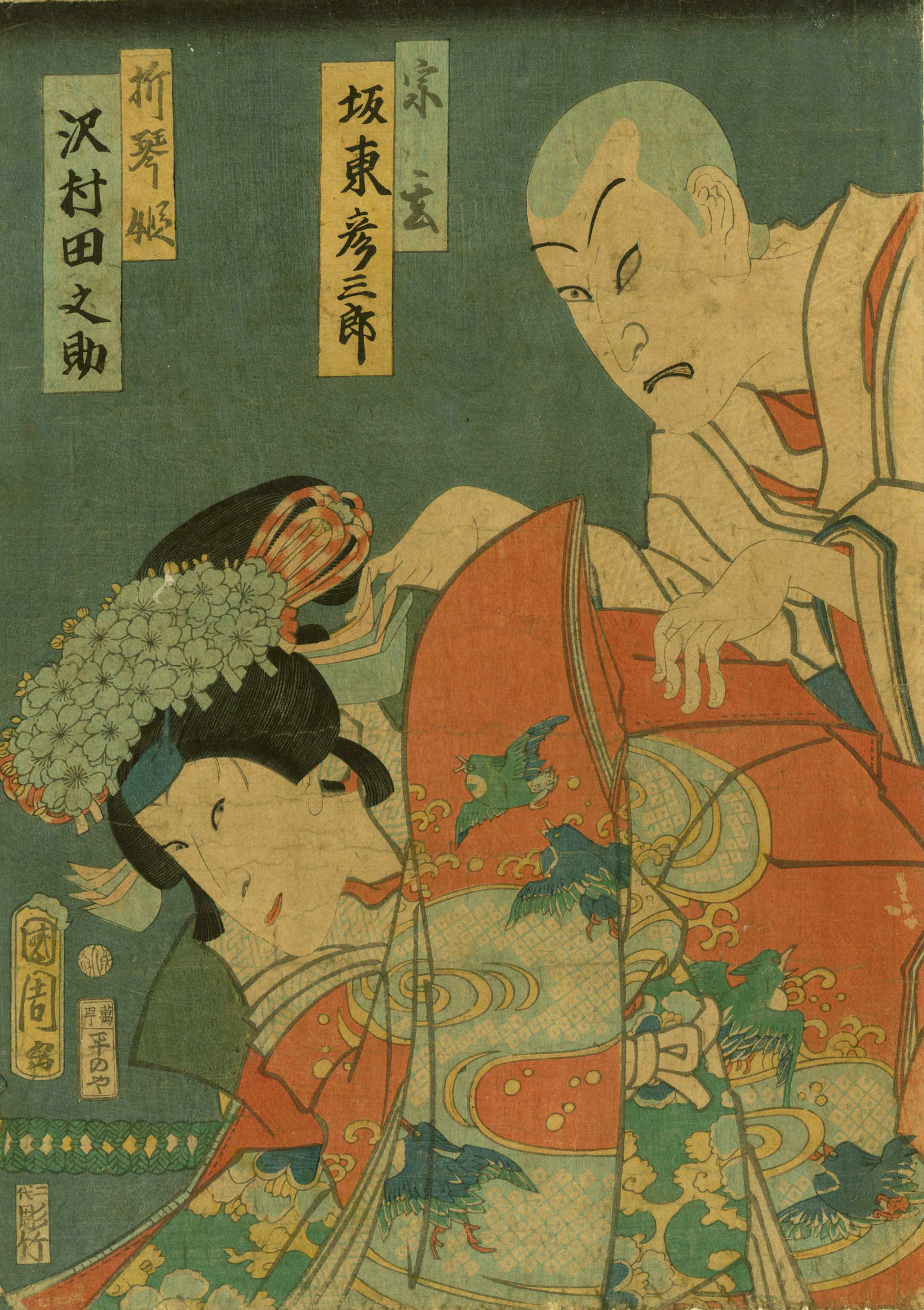
W240xL360mm, Japan

This is a Japanese wood block print by the artist Kunichita, published in 1862 by Hiranoya.  Kunichita was the founder of the Toyohara School and was one of the most famous ukiyo-e artist of his time.  His love with the Kabuki theater led him to work on ukiyo-e actor prints (prints of the kabuki actors and scenes from the popular plays).  In 1867, he was commissioned by the Japanese government to produce 10 pictures for the World Exhibition in Paris.  This exhibition strengthen the Japonism influence in the European art world.

This print is about the Kabuki play where monk Sogen (played by Bando Hikosaburo) became infaturated with the beautiful courtesan Orikotohime (played by Sawamura Tanosuke).  For this Sogen was expelled from the temple, tragically  Orikotohime died and he was left alone.

L150xW120mm, China

Wood block print presented on greeting card.

W100xL290mm, China

This is an old wood block printed script in 2 volumes of a popular Buddhist sutras in Chinese.  The sutra was translated into Chinese in Tang Dynasty; it was presented as a dialogue between the Buddha and Ksitigarbha.  The teaching is about the the ultimate sense of a universal code of duty for all living beings.

W60xH120mm, China

These opera dolls have been a popular toy in Beijing since the Qing dynasty. The head and the base of the doll is made of clay, the structure with the stem of millet covered with a beautifully painted paper.  However, the most important construction of the dolls are the 2mm tall bristle at the bottom of the base.  They will be played on a bronze tea tray.  By tapping lightly on the tray, the figurines would move in a rhythmic fashion just as they would in the beijing opera.  Apart from being a toy, they are also used for performance, “bronze tea tray opera”; the required characters for the opera would be put on the tray, matched with real life opera singing.

W220xL300mm, China

This is a wood block print of the Kitchen God (Zao Jun) which traditional would be placed in the kitchen. He has been worshiped by the Chinese since about 1050BC!  The Kitchen God is believed to control the fortune of the household; at the end of the year (form 23 to 30 December of the lunar calender) he will report to the Jade Emperor all the kindness and evil deeds the family has done over that year.  The two assistant gods by his side, one hold a can with the record of the kind deeds and the other the evil record can.  Before the Kitchen God depart for his yearly duty, the families (usually on the 23rd) would make offering to thank him.  The offering are all sweet and gluey food, hoping it would stick to his mouth and sweet things would be said in his report.  Others would add a pair of couplet note to remind him, wine to to make him drunk etc.  hmmm … (also see The Return of the Kitchen God-01/26/2012)

W500xL600mm, China

Though paper is one of the 4 great invention of China, handmade paper is a dying art.  To earn a living from making paper is hard work; there are all together 72 steps!  This is only a rough idea what is has been done to make the paper.

First, in late spring young bamboo are collected from the forest, these 2 m long bamboo are then cut into 2 cm wide stripes.  These stripes are soaked in lime water for 2 to 3 months.  At the point, the bamboo would have turned yellowish, they are then rinsed and cleaned with water and the knots and the outer skin will be removed.  These stripes are then put in a 5 m long x 1 m wide wooden trough for stomping (just as grape stomping for wine).  Now we finally have the paste for paper making; the paste is put into a 2 m long by 1 m tall wooden trough and mixed with a glue solution.  A deckle with fine silk sieve mounted on a wooden frame is lowered into the paste and then taken out, after the water is drained away a thin layer of paste is left.  The paste sheet is flipped out on wooden board, silk sieve removed and we have a wet piece of paper.  These wet paper is piled up and water squeeze out under the wooden press.  Lastly, the paper are separated and posted on the drying room one by one.  These workshops are usually run by 10 people;  2 for the stripping of bamboo, 2 for stomping, 3 for sieving, 2 for drying and one for all the other bits and pieces.

L150xW110mm, China

The opera character of this paper cutout is Wei Chi Gong of the Siu dynasty who was persuaded to defect from Siu to join the first Tang empire by the Tang emperor.  The story of the opera begins when Wei was still a general of the Siu empire whom went on war with the Tang, not only did he won, he disarmed a Tang general Yuan.  This general was humiliated and when Wei join the Tang empire, he made up excuses to have Wei killed, luckily the plan failed.  Years later, when the Tang emperor was losing his war, general Yuan left him and ran for his life.  Luckily Wei arrived to save the day.  This is Wei story in the opera but perhaps you know him as the Chinese door god, but that’s another story…

W80xL150xH100mm

We need your help!  This is a paper mache pig that was acquired a long long time ago, the origin of this item is unclear.  Perhaps someone can enlighten us?  Korean?  Thai?  Chinese?  Vietnamese?

W220xL300mm, China

Over Chinese New Year, wood block prints which express good fortune, blessing and protection would be posted in every household, shops, basically anywhere with a roof over (even at livestock are kept).  These prints are replaced on every New Year.  This print is of the Eye Goddess of the Taoist religion, she is one of the 15 mother goddesses, it is believed that her prayer would heal any problem of the eye.  The  Goddess print will be displayed in clinic of an eye specialist and at home of those that have sight problem.