Archives for category: paper

monkey

W150xD50xH110, China

A roly-poly monkey toy.

The story goes like this; in the Sung dyansty, there was an additional of a baby boy to a wealthy household.  Precious and spoiled, he cried every night till dawn.  Worried that something was wrong, the family consulted all the well known doctors in town but cries continued.  One day, the father came home with a clay toy shaped with a rounded bottom and a small top.  The child pushes, it wobbles and bounces back, it amuses the child and the crying stopped.  The father believed that it was a blessing from god and had the figure of Guan Yin painted onto it, hoping it will protect his family from toppling.  Unfortunately, one day the child broke the clay toy in half, a bad omen the father thought but the clay cannot be put together again.  Cleverly, he used the broken toy as a mold and created a paper mache version and it became a popular folk toy in China.

print

W220xL300mm, China

The title of this wood block print is called “Buddha of the West Sky”, referring to Siddhattha Gotama of India.  The idea of the West Sky is complex, in the early days the sun is believed to be a godly object; raising from the east, watching us on the day and going away and setting on the west.  It is believed that while we sleeping the sun will be watching over in the west sky.  With Buddhism introduced to China from India, a country to the south west, India, the West Sky, is the place where the truth, the important scripts are.  Monks, notably Xuanzang (depicted in the novel the Monkey King), went to India to find enlightenment.  The West Sky symbolizes a cleansed soul and mind, a nirvana world.

Yang Liu Qing

W1150xH670mm, China

This old Yang Liu Qing print, depicted a scene from a Tang dynasty poem, 商山早行 Morning Journey At Shang Shan.

晨起动征铎,客行悲故乡。
鸡声茅店月,人迹板桥霜。
槲叶落山路,枳花明驿墙。
因思杜陵梦,凫雁满回塘。

After a restless night thinking of my home town, I woke up with the hurrying bells of the inn.
The rooster crow at the frailing moon, on the frost cover bridge left the footprints of the travelers.
The down hill road is covered by wilting plants, orange flower shines out on the inn wall.
Seeing the sunrise, I thought of my dreams of ansers returning to the pond, maybe too I can see my family soon.

The people on the print, however, described another story;

人家骑马我骑驴,回头再看推车汉,比上不足 比下有余!

I ride a donkey and look up to those who ride a horse, but looking at the cart pusher I feel content.

wood block printW600xL1750mm, China

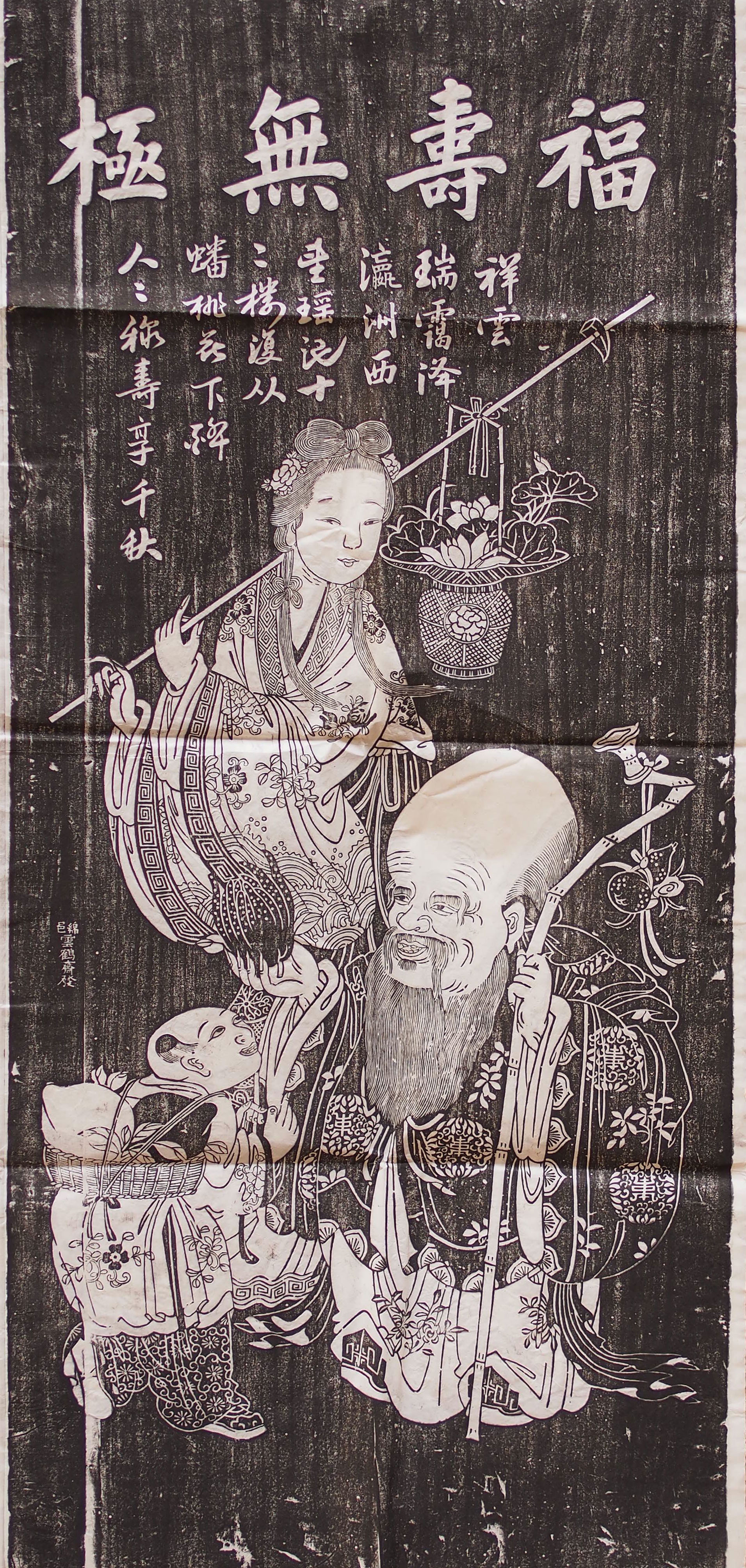
This birthday print is filled with blessing symbols –

God of Longevity who is holding a cane on one hand and the Buddha’s hand fruit on the other hand.
The lady of behind is Ma Gu, the female God of Longevity with a basket full of magical plants.  Unlike the God of Longevity who has an appearance of an old man with a protruding forehead, Ma Gu is portrayed as a beautiful girl in her late teens.  In the legend, every year on the 3rd of lunar March, on the birthday of the Queen Mother of the West, Ma Gu will give her best wishes.
Lastly, the child saint carrying a basket full of longevity peaches, also a well known theme for birthday blessings.

Unlike the birthday scroll being a respectable birthday present for the elderly lady that would be held around birthday time, this is a Mian Zhu new year print that is pasted on the wall on Chinese New Year and to be replaced yearly.

paper mache tigerW60xL140xH90mm, Japan

ASIAN FOLKCRAFT COLLECTION

Though tiger is not native to Japan, its worship has started before the first tiger was imported from Korea some 400 years ago.  The figure was generated from painting, tales and imagination, it is believe that the tiger is a symbol of strength and health.  This is a paper mache tiger with a noddy head.

Here is a collection of the paper mache tiger wood block print by Shirayanagi Eiichi (http://www7b.biglobe.ne.jp/~kokakuro/essay/110619shiroyanagi/toratoratora.htm to see the complete description)


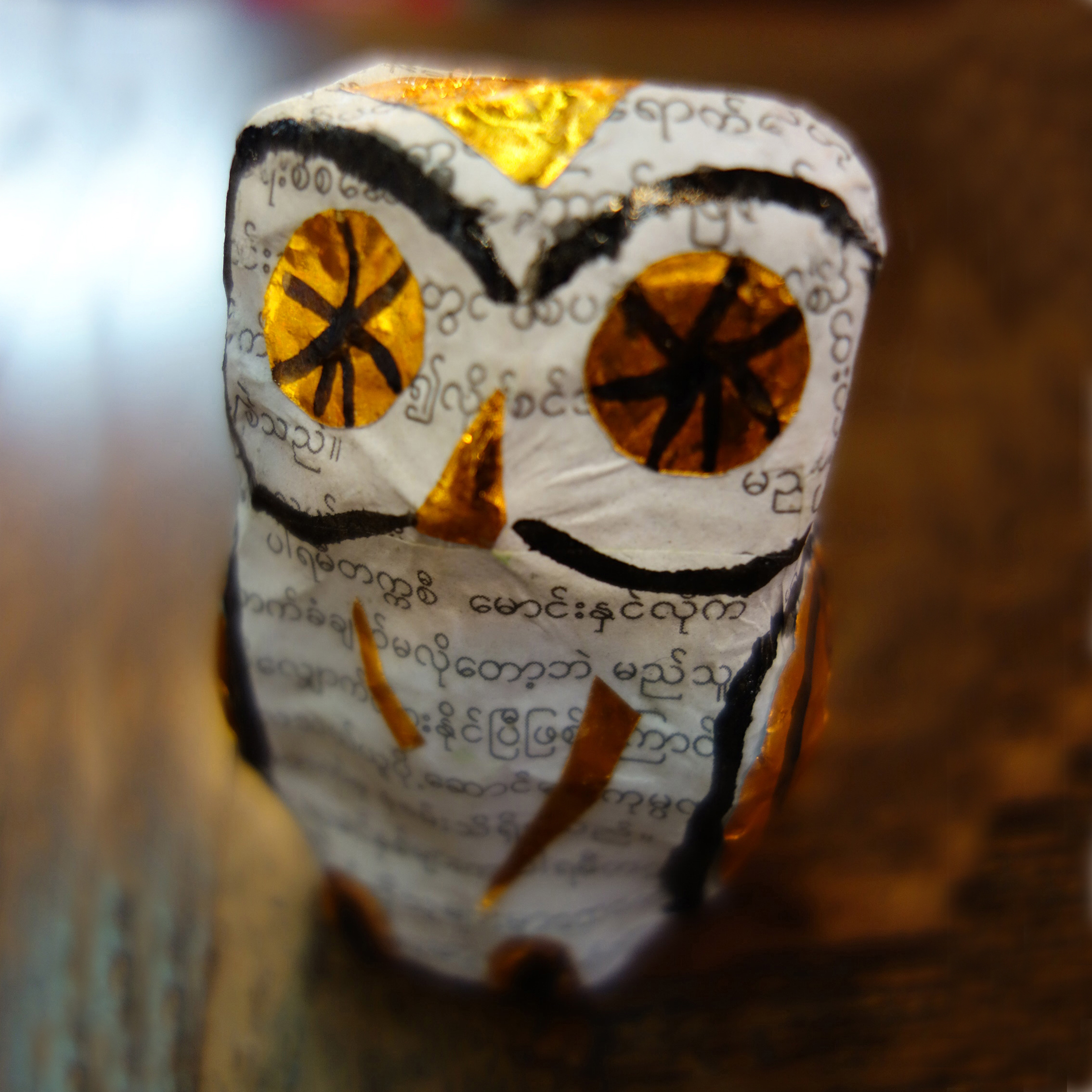
burmese owl

W45D30H60mm, Mynmar

The Zee Kwet (or) the Myanmar Owls are believed to bring luck and prosperity to a family.  The owls usually comes in pairs, a male owl and a female owl.  But there is something more. At the base of the female owl, a tiny owl is also painted on it, to make it looks like a family.

SOIL X MOUNTAIN FOLKCRAFT
ASIAN FOLKCRAFT COLLECTION

Burmese Note Book

L200xW130mm, Myanmar

This note book is made entirely by hand in Shan State, eastern sector of  Burma.  About 11 miles from Hsipaw in Shan State South lies Kyinthi Village beside Mandalay-Lashio Union Highway.  Farming and orange is the economic mainstay of the village.  Besides, there is a traditional cottage industry there which is production of Shan paper or Mongkai paper in which every house in the village is engaged for extra income.

Shan paper is made from the bark of tree called “Sar”.  Such trees grow wild naturally.  Shan paper or Mongkai paper is manufactured over one million sheets per month.  Some Shan villages make the paper to be thick enough to use as bed sheets whereas some use it as waterproof wear after coating with lacquer.

Item from Soil for the ASIAN FOLKCRAFT COLLECTION

paper mache cow

W90xL200xH230mm, Myanmar

Burmese paper mache is usually made by applying layers of thin, tough, paper and rice paste to a clay model of an elephant.  After drying for a day or two, the object is then given a coat of white paint. The body is painted with brightly coloured enamel paints.

These paper maches are not only toys.  A donor may commission objects in different shapes for presentation to a pagoda or monastery on special occasions.    They are usually made by craftsmen or their families in the vicinity of the pagodas.

This animal paper mache collection from SOIL is avaible at Mountain Folkcraft during the ASIAN FOLKCRAFT event.

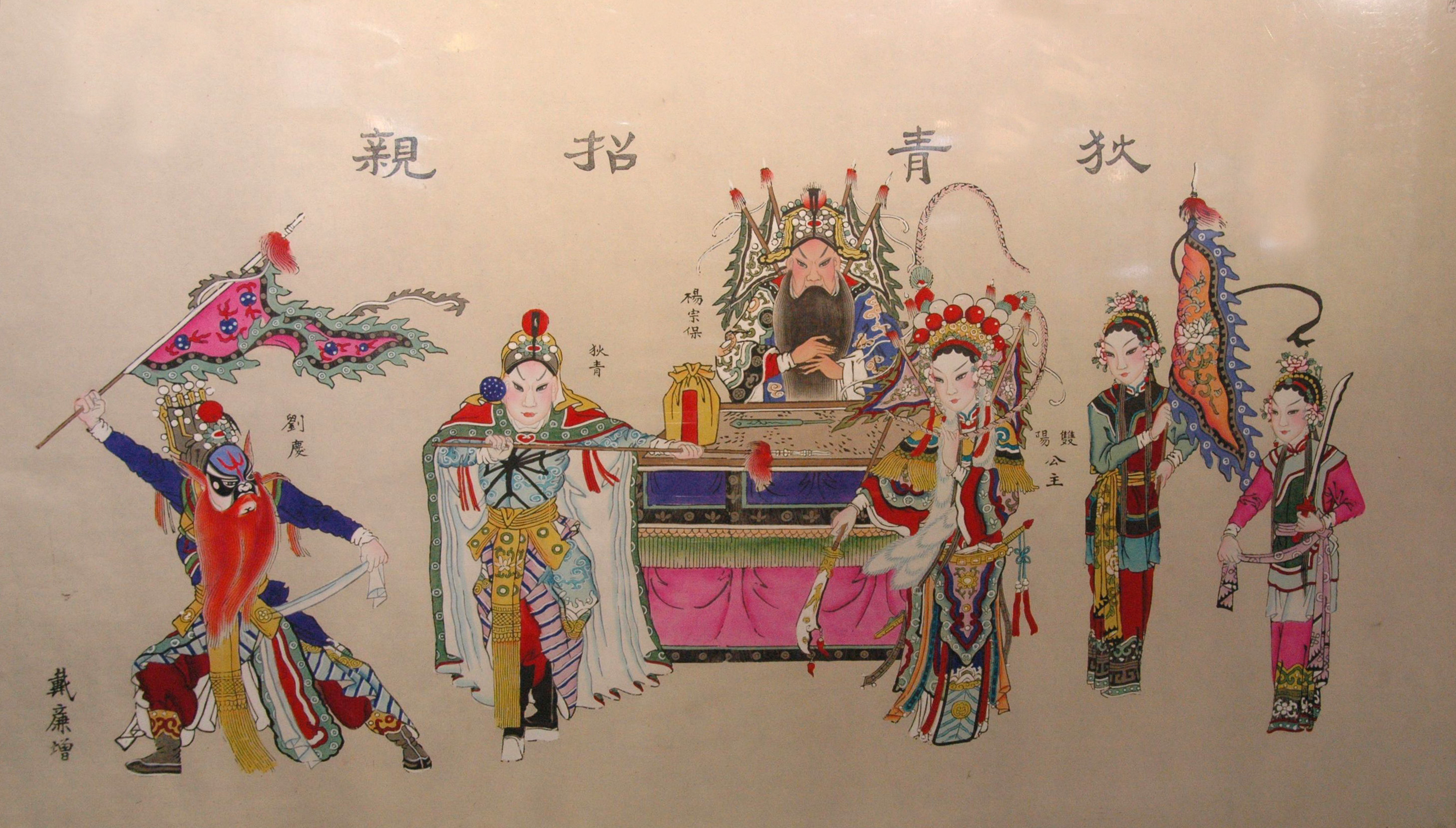
L1200xH700mm, China

This is a Yang Liu Qing wood block print portraying the story of the fearless Song dynasty warrior Di Qing (2nd left).  The story has it that Di Qing and Liu Qing (1st left) of North Song was send by the Emperor to pacify the uprising to the west of the country.  Unfortunately the army got lost and ended up in a wrong country, Dan Dan.  There, Di Qing met the Dan Dan princess (3rd right) who fell in love with his looks.  She lured him into the palace and asked for him to surrender and to marry her.  Unwillingly, Di Qing wedded the princess but only thinking about escaping to defend his home land.  The princess was upset that her newly wedded husband has departed without a word and set off after him, Di Qing explained about his duty and promised to return after his task.  Like most plots, the hero forgot about the princess when he returned home with victory and never returned to Dan Dan.  This time the princess was furious and led an army to attack Song, general Yang Zong Bao (center character) was no match with the princess and instructed Di Qing to deal with the princess.  When the couple met, of course they forgot all about fighting and lived happily ever after …

Here is the opera version of the same story

Kung Kee Fat Choi

W200xL150mm, China

Wishing you a happy Chinese New Year this coming Sunday with this paper cutout.

This paper cutout is full of blessing symbolism,
Lotus Plant; 蓮 (Lian) is has a similar pronunciation as 年(Nian) which means yearly and as its fruit has many seeds it is a symbol of  frequent fertility.
The Fish, 魚 (Yu), has the same pronunciation as the word “surplus” 餘.
The pattern is symmetrical, portraying 2 of each item, the Chinese believes the bad luck comes in singularity (odd) and good in double (even).
Lastly, the words in the middle is of course the famous Kung Kee Fat Choy!

The paper cutout are normally displayed on the windows of every household with different idea of blessing.
So here wishing you a year of surplus, fertility and many Fat Choy!