
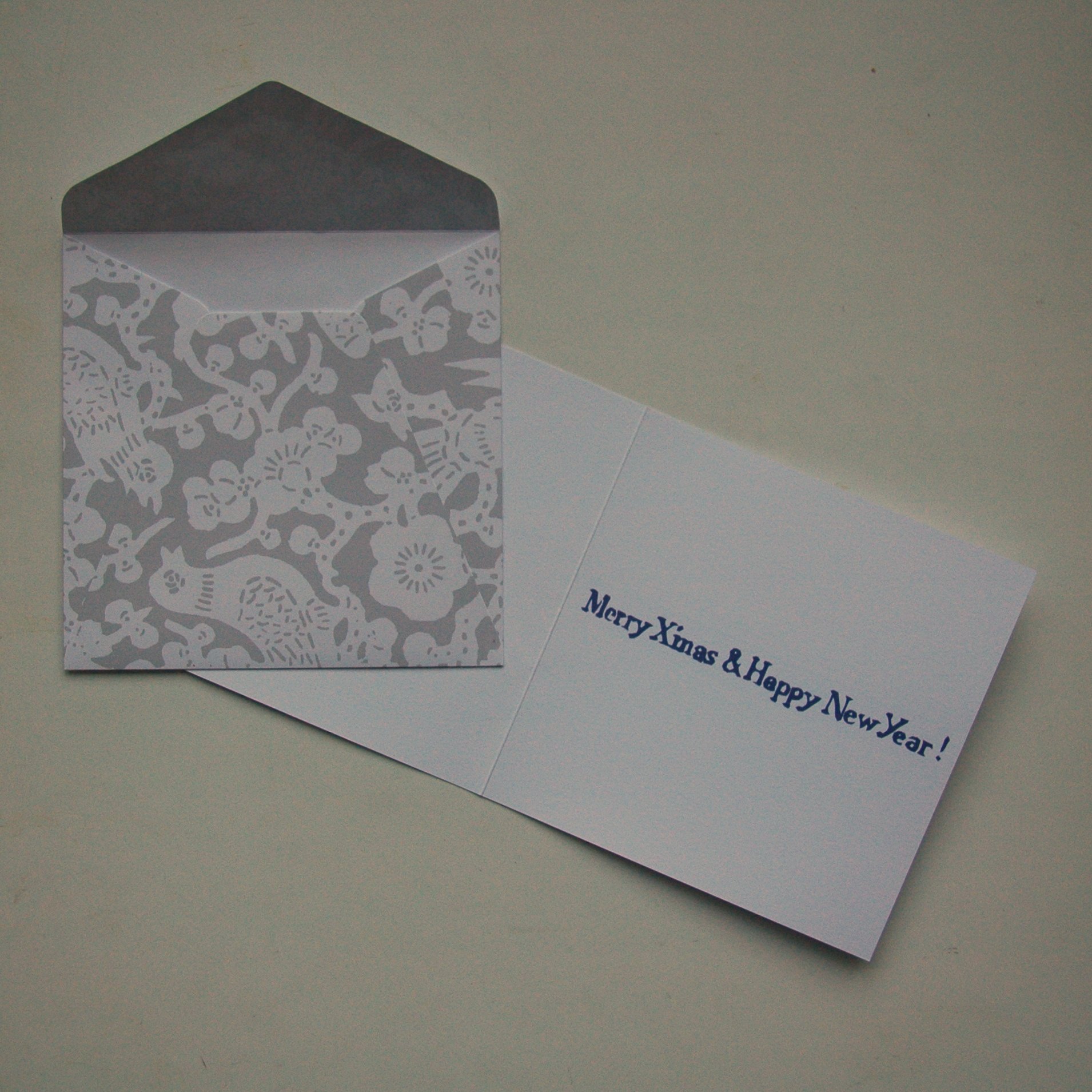
W140xH140mm, Hong Kong
Its about time to write your X’mas cards, check out our newly designed cards!
W140xH140mm, Hong Kong
Its about time to write your X’mas cards, check out our newly designed cards!
 W280xL320mm, China
To celebrate Halloween we have a new year print of the god of Feng Du, Feng Du is a physical province in China where it is believed to be occupied by ghosts and spirits, a city where the dead goes to live. (unfortunately since the Three Gorges Dam project, the ghost town is now submerged in water with only a small island remaining, so there is little chance of visiting it before death. well, it will be rather cramp as well … o dear) For Taoist, the god of Feng Du is the controller of all spirits and is in charge of the Hell god, Yan Luo Wanɡ (Yamaraja), he also has 72 helpers who monitor on people during their life time. At death everyone would be led by officials with the head of a cow and a horse to Diyu where one’s deed will be judged, life long sins will be punished. At the end of the punishment (the length of time will depend on the sins) one’s spirit will be renewed and reincarnated into the next life.
Diyu is divided into 10 courts each headed by a Yama king (their portraits are shown on the 2 sides of the print) who reports back to Yan Luo Wang.
Court 1: Jiang, King Qinguang – in charge of life and death
Court 2: Li, King Chujiang – in charge of the Frozen Hell
Court 3: Yu, King Songdi – in charge of Black Rope Hell under the sea
Court 4: Lü, King Wuguan – in charge of the Blood Pond Hell
Court 5: Bao, King Yanluo – in charge of the Screaming Hell under the sea
Court 6: Bi, King Biancheng – in charge of those who died before their time
Court 7: Dong, King Taishan – in charge of the Minced Meat Hell
Court 8: Huang, King Dushi – in charge of the Stewing Hell
Court 9: Lu, King Pingdeng – in charge of Avici, the darkest hell of all
Court 10: Xue, King Zhuanlun – in charge of reincarnation

W900xH1040mm, Hong Kong
This is a modern door god design by my father, this is a silk screen print on a cloth, the traditional door gods are wood block print to be posted on the doors to offer blessing and protection to the household.
One of the legend for the origin of the door god goes like this; according to the Qin geographical documentation “Shan Hai Jing”, in midst of the ocean there is a mountain, there stood a giant peach tree which spread over 3000 miles. At the north east is the door to the dark world where the ghosts go in and out. Over this door stood 2 gods – Shen Shu and Yu Lv, their duty is to censor the good and the bad ghosts, the evil ghosts will be thrown down the mountain to feed tiger. The character here is Yu Lv, brother of the Shen Shu, the pair are the legendary ghost busters.

W900xH2200mm, China
This silk embroidery painting is a traditional gift for birthday of a lady of high social status. In figure in the embroidery is the saint Ma Gu and the phoenix (queen of all birds) going to give her best wishes the Queen Mother of the West (the supreme head of all female saints) for her birthday. On the tray that she is going to present to the Queen Mother has a few of the magic peaches which are believed to take 3000 years to flower, 3000 to bare fruits and another 3000 years to ripe, a bite of it will make one immortal. The peach is a symbol of longevity, it was also featured in God of Longevity.
Unfortunately the closest we can get to the magic peach is through pottery, carving and paintings, but if you would like to try the worldly version, it is known as the Saturn Peach (Prunus persica f. compressa), they will not make you immortal but they are super delicious.

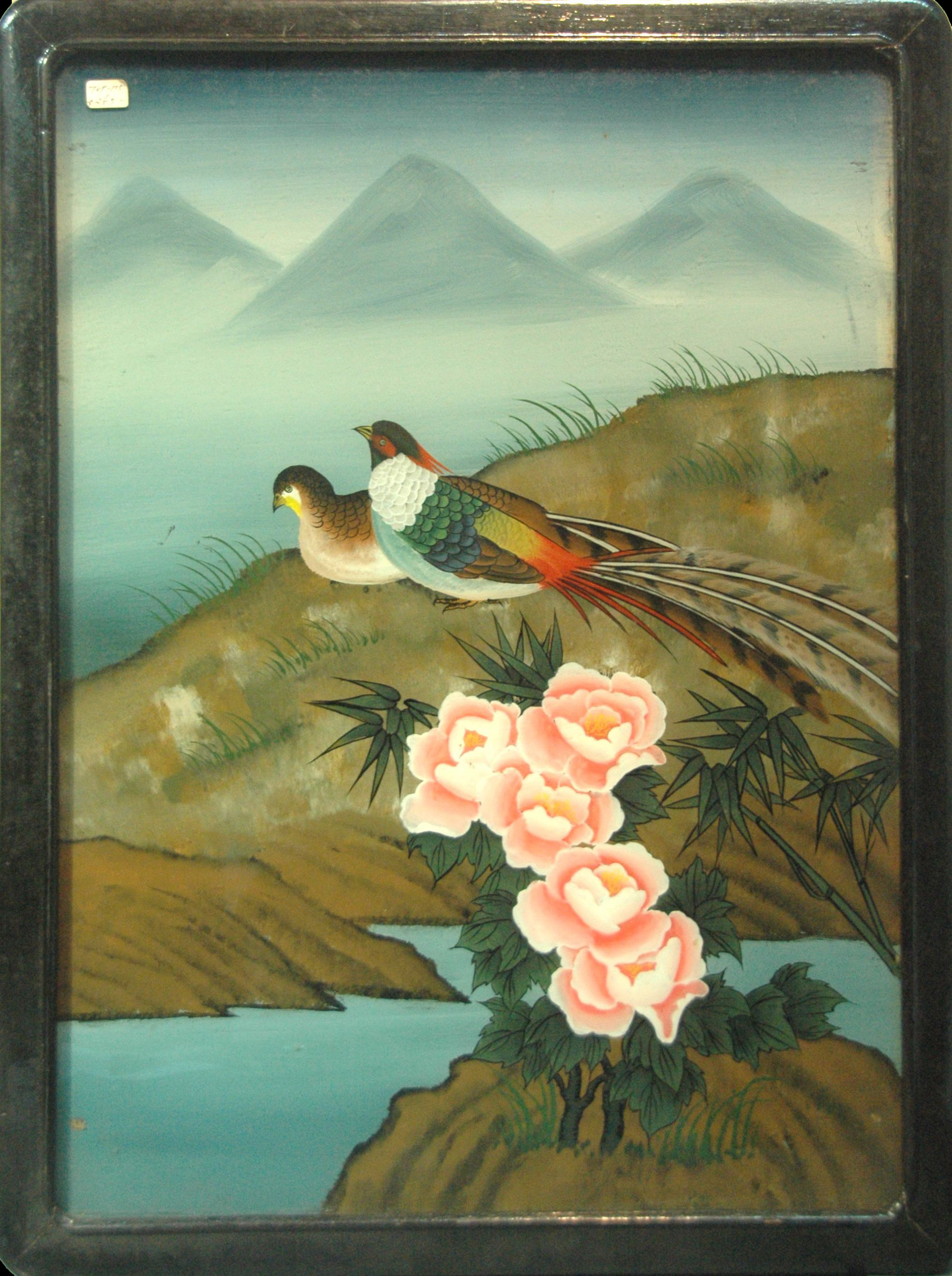
W450xH600mm, China
This is a glass painting of a pair of Lady Amherst’s pheasant (Chrysolophus amherstiae) which are native to south western China and north eastern part of Myanmar. For the Chinese, the Lady Amherst’s pheasant is a noble bird. At the time of monarchy the Empress, being the highest ranking second only to the Emperor, would have phoenix as a pattern. For the first ranking official, their costume would have a red crown crane, while the second ranking official the Lady Amherst’s pheasant. The third ranking, the green peafowl and the fifth the silver pheasant, the eighth being the quail.


W410xL230, China
Here is a folding fan with the fan leave decorated with a poem and painting by my father. The poem from the poet Bai Ju Yi, “The Jackdaw’s Nightly Cry”,
“慈乌夜啼”
慈乌失其母,哑哑吐哀音。
昼夜不飞去,经年守故林。
夜夜夜半啼,闻者为沾襟。
声中如告诉,未尽反哺心。
百鸟岂无母,尔独哀怨深。
应是母慈重,使尔悲不任。
昔有吴起者,母殁丧不临。
嗟哉斯徒辈,其心不如禽。
慈乌复慈乌,鸟中之曾参。
The Jackdaw cries for the lost of its mother.
That year it stayed at their forest home; by day and by night.
Every midnight it cried, tears would run down those who heard.
As if it was saying it has not taken care of its mother.
Hundred of birds are without mother but only you are grieving so.
Your mother’s kindness deepens your sorrow.
There was general Wu Qi too busy chasing fortune to attend his mother’s funeral.
These kind of humans are worse than birds.
The Jackdaw is the dutiful son of birds.
Here is a clip of a jackdaw to make up for my bad translation of poem.

W220xL300mm, China
The character on this wood block print is not a Chinese version of Avatar but the hero Guang Hui Wang who was attributed the title of the country’s protector. The name Guang Hui Wai is itself a title given to him by general Chen when his effigy was worshiped during Chen’s battle to pacified Ziang Ziu some 300 odd years later. Guang Hui Wang became an idol god in Ziang Ziu and the legacy spread to Taiwan and South East Asia through the immigration of the Ziang Ziu people. Now back to Guang Hui Wang, his real name is Xie An, he lived in East Jin dynasty (320-385 AD). Xie An was a great scholar as well as a politician and a military leader. Apart from winning numerous battles, reclaiming lost territories and resolving disputes between nobles within his country; he is much admired for speaking and acting with morality and justices, not taking sides in the court and lastly being able to step away from power after battles were won. Xie An was borned in a established family, he was well known for his intellect, charm and good looks (this being reconfirmed by his poem with the famous Wang Xi Zhi and his portraits) … who someone please explain why he has turned into Avatar in all the new year prints?
Here is a clip from the procession in Southern Taiwan for Guang Hui Wang and the Xie family.

W40xL60x10mm, China
This pendant is made from a piece of broken ceramic, from the shape of the piece it is likely to be of a medium size jar or a vase. The figure on the piece is part of the a war story, these figures or themes are known as Knife-Horse-People which is a popular theme in the Qing dynasty. See here for the clay version of Knife-Horse-People.
Though completely different, this ring seems like part of the portrait jewellery collection.
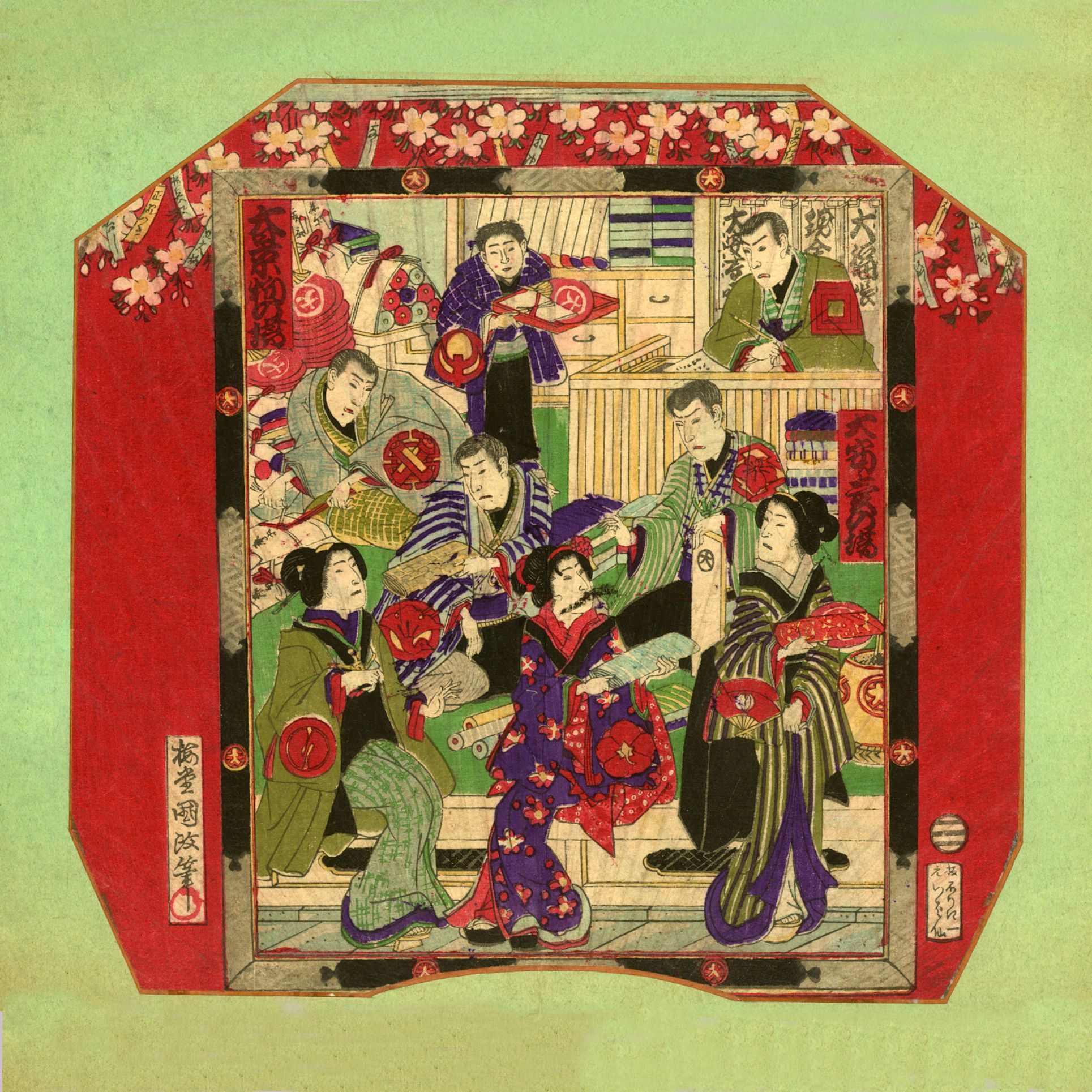
W300xL220mm, Japan
This ukiyo-e print is a work by Baido Kunimasa (1848-1920); born Takenouchi Hidehisa during his career he used different names (go) for his works, Baido Hosai, Baido Kunimasa, Kochoro, Kunimasa IV, Kunisada III, Toyokuni V and Toyokuni V.
This print depicts the on going in a kimono shop. Wonder if it was something like a xmas shopping day, everyone looks really stressed out in the picture.

CIR 55mm (UK size O), China
I had a similar ring when I was a teenager, it was one of my favorite. It has a “pure silver” mark in Chinese (but as a human guinea pig I can verify that it is really pure silver as I suffer badly with metal allergy, only pure gold and silver would pass the test, how posh is that!)
Enamel was brought into China from France in the Qing dynasty (17th century) and was immediately adored by Emperor; workshops for the court were set up in Imperial Court in Beijing and in Guangdong. It then became popular throughout the country during the reign of the next 2 emperors. The type of enamel produced in China was mainly cloisonne, where a thin wire is applied to form cells to hold the enamel.
 Mountain Folkcraft