Archives for category: figurine

golden wood carvingL210xD35xH100mm, China

The character in this golden wood carving is known as Lin Bu, a poet in the North Sung dynasty, he is surrounded by plum blossoms and there is a crane by his side.  Lin led a hermetic life on a small hill at the West Lake in Huangzhou, never setting foot in the city, he found company with the monks whom he would visit with his small boat.  Lin also admire plum blossoms which he planted around his hut, this also inspired him to write poems about them.  Lin also kept a couple of cranes for company.  It is said that if he got unexpected guests visiting while he is out on his boat, the cranes would flew to him, hoover above his boat and gave him his message.  Lin was never married, the plum blossom being his wife and the crane his sons, this phrase 梅妻鶴子 (Mei Qi He Zi) became a description for a hermetic life.

dollW130xH220mm, China

A gentle fabric doll dressed in indigo dye costume.

Here is the local designer Furze‘s abstract version.

fish sculptureW15xD24xH42mm, Hong Kong

A paper sculpture of a three dimension impression of a fish swimming downward.


clay toy

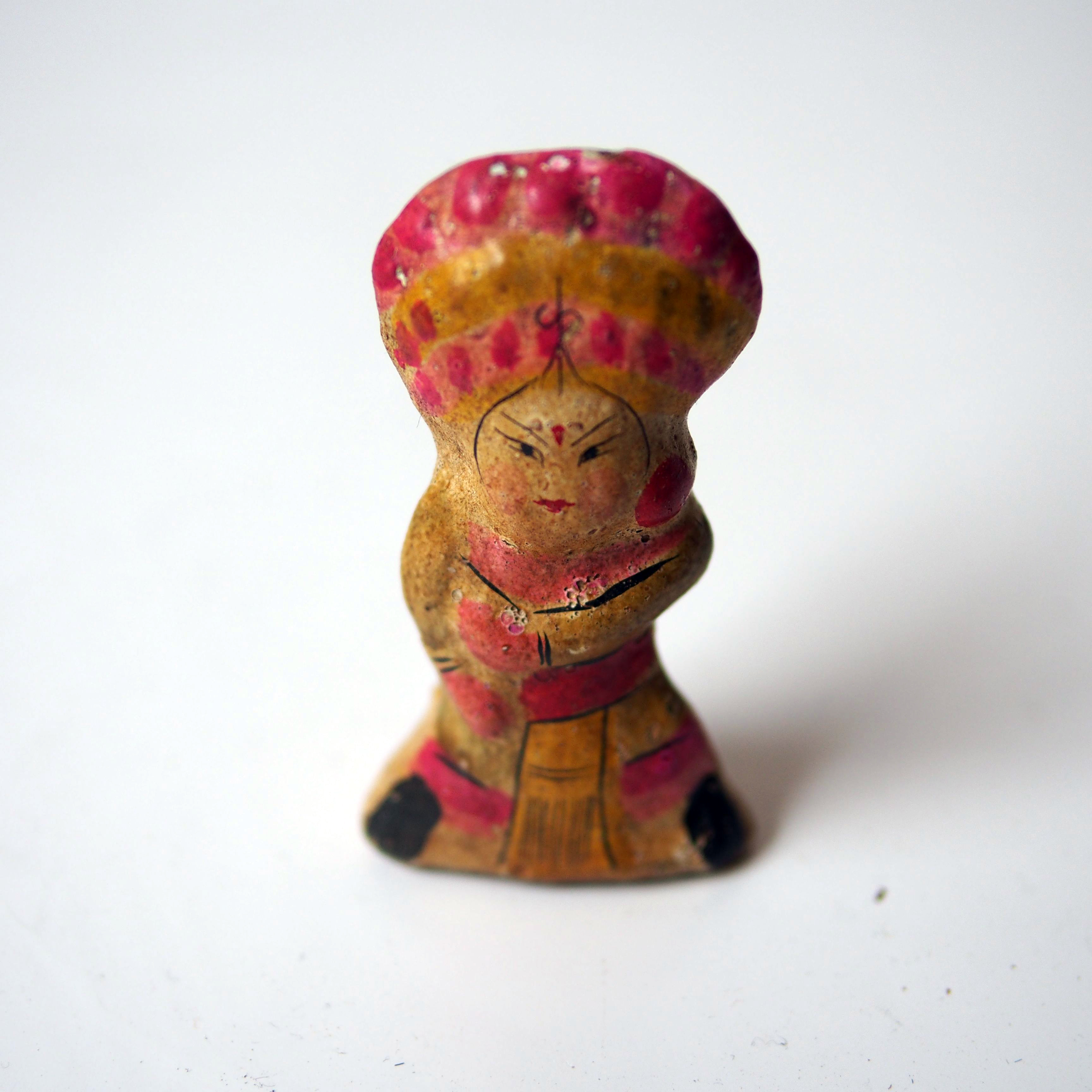
W50xD20xH80mm, China

Clay toys, like Disney toy, often take the form of a famous character, be it from a movie or an opera.  This figurine is Hu San Niang, one of the three female warriors on Mount Liang in the novel “Water Margin”.  Hu was the daughter of  a powerful family, not only is she beautiful she is also well trained in military.  After many victories for the family she was captured by the warriors of Mount Liang (108 outlaws that do good for the people) and soon she joined in and became the 59th warrior.

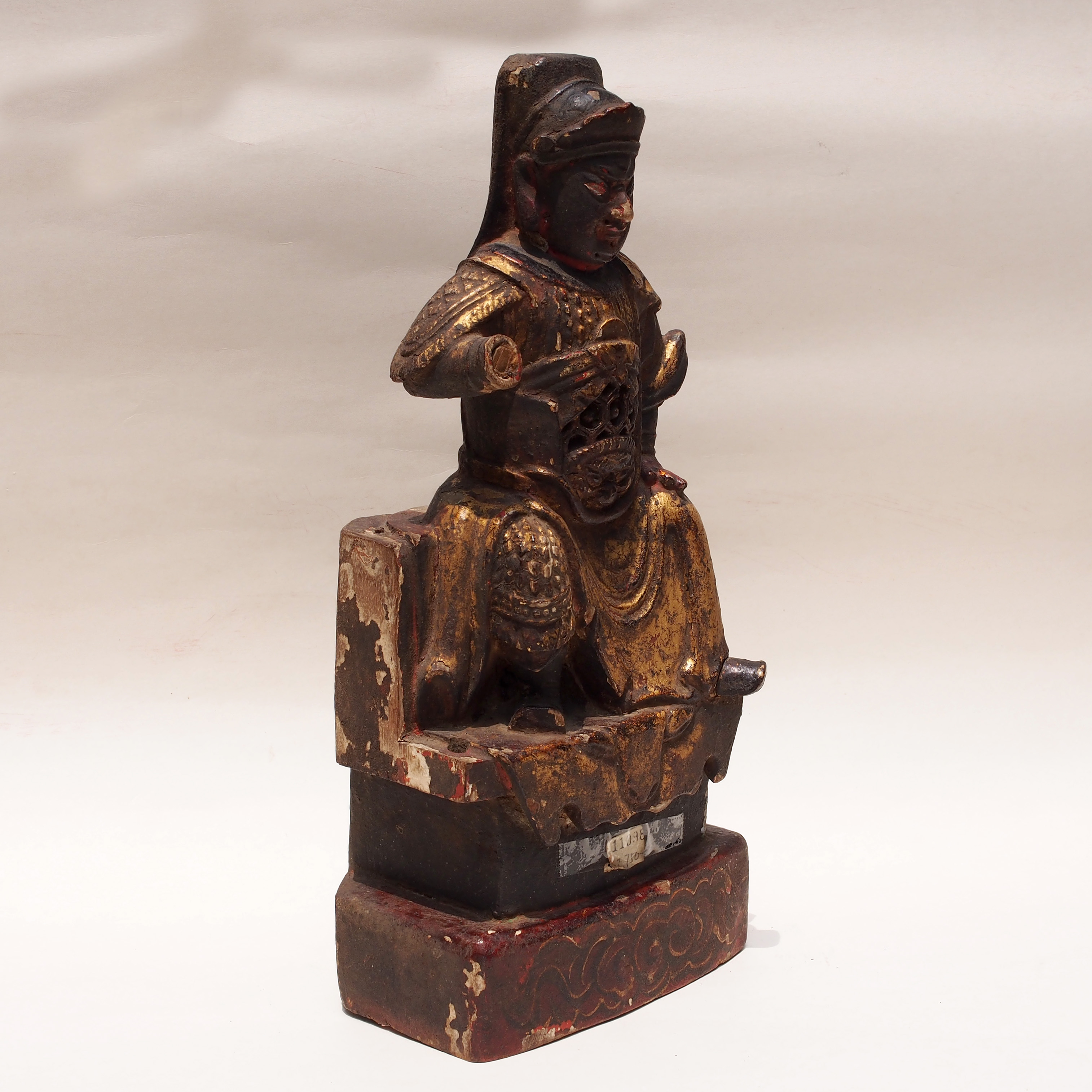
figurineW140xD100xH320mm, China

This is a figurine of Bei Di, who is the Prince of  Shang dynasty.  In a dream, the Queen swallowed the sun and felt pregnant after 14 months Bei Di was born.  Though being the heir of the kingdom, he was more interested in meditation than in the power he was born into.  Finally, he left his parents and went to Wu Dung to study Taoism.  After 42 years, he was sainted by the Jade Emperor.  It is also believed that he is the 82 reincarnation of the Tai Shang Lao Jun.

There are several Bei Di temples in Hong Kong which is well worth visiting.
There is one in Wanchai, Sham Shui Po and Cheung Chau.

figurine

figurine
W85xD70xH200mm, Hong Kong

This is an effigy of a elder female ancestor of the Tanka tribe.  These ancestor figurines were kept at the boats of the Tanka fisherman offering them safety at sea.

Click here to see our other junk boat gods.

clay toyL160xD40xH160mm, China

A clay toy of a boy sitting on donkey.

This figurine reminded me of a childhood fable.  A man and his son were on their way to the market with their donkey, a passerby saw them and said, “You have a donkey why not ride on it, such fools!”  The man thought that’s true, so he put his son on the donkey.  Its not long before someone else commented, “What a lazy boy, he lets his old folk walk while he rides.”  The boy got off and asked his father to ride the donkey.  Then another person said, “What a father, he rides the donkey and lets his young son walks.”  So the man pick up his son and the two rides the donkey together, when they got to the market, someone scolded at them, “What a cruel family, two of them riding on a poor skinny donkey.”   The man and the boy got off, feeling a bit bad, and thought the right thing for them to do is to carry the donkey, so they found a pole and tied the legs of the donkey to the pole and carried it upside down.  The donkey hated it, just when they were crossing the bridge the kicking wiggled and cause the boy to drop his end of the pole, the donkey fell into the river and drowned.  “This will teach you!”, said a man who saw what happened.

horse

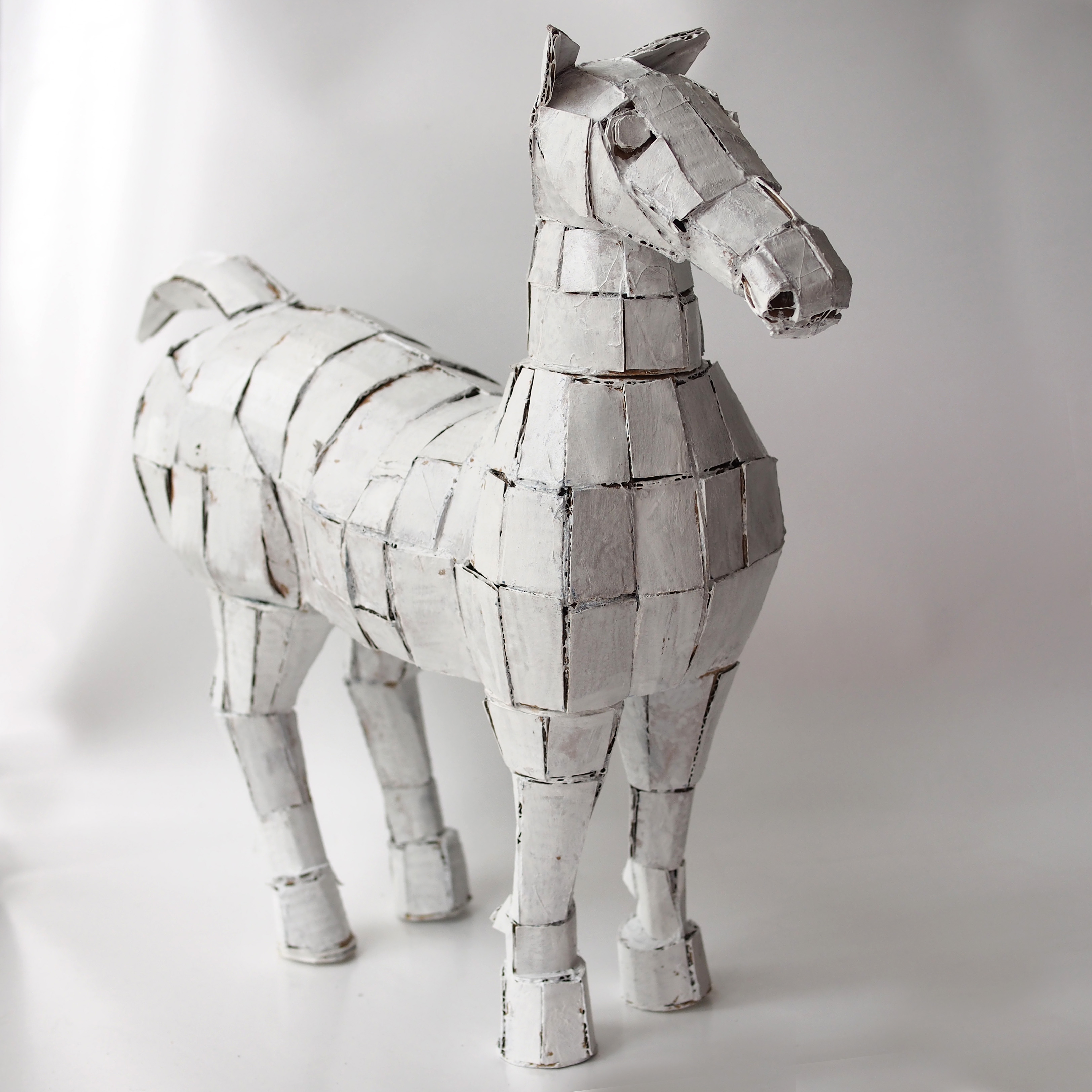
W100xL300xH300mm, Hong Kong

Inspired by the Han dynasty wooden horse, this white horse is constructed entirely with paper.

Horses were highly priced in the Han dynasty (200 B.C. – 220 A.D.). The use of war chariots started in the Warring State period (450 B.C.) and gradually replaced by cavalry in the Han dynasty. This change was brought about by the discovered of the heavenly horses, a superior breed that is found in the Feghana Basin (today’s Afghanistan). Failing to obtain these horse peacefully, lengthy wars took place; Chang An, the capital of Han, is far far away from Feghana Basin (some 2000km away, that is if we take the plane, and much more by foot). The long journey was exhausting and food soon ran out, by time the Han army reaches the Feghana Basin, the starving troops were defeated even by the smaller war lords. General Li Guang Li, led the remaining of his men back to Chang An. The emperor gave the general a larger army and a large supply of food and sent off again. This time they reach the Dayuan capital, Khujand, with no difficulties. The Han army was no match with the enemy, half the men was killed in the first battle. General Li changed his plan and instead of fighting with the Dayuan, he succeeded in cutting off the water supply to the city. Within the city the nobles revolted against the ruler and offered a tribute of 3000 heavenly horses.

figurineL160xD100xH120mm, China

A Shi Wan figurine of a gentlemen admiring a piece of inkstone, on the bench is an armrest for calligraphy.  He is Su Dong Po, a very known scholar of the Sung dynasty, also well known is the recipe for double cooked pork belly.  Amongst the inkstone collectors, Dong Po is a inkstone fanatic and his dispersed collection is well thought after by many today.

A good sword is well treasured by a martial artist, like a mirror to a beauty and an inkstone for a calligrapher.   When Dong Po was a boy, he found a green piece of stone which is perfect for testing ink, realizing its a rare find his father had it made into an inkstone for his son.  Dong Po had it by his side throughout his career and treasured it so much that he inscribed a piece of writing on the back of the stone, the famous “sky stone”.  Knowing of his hobby, the emperor also rewarded him with other good pieces of inkstones.

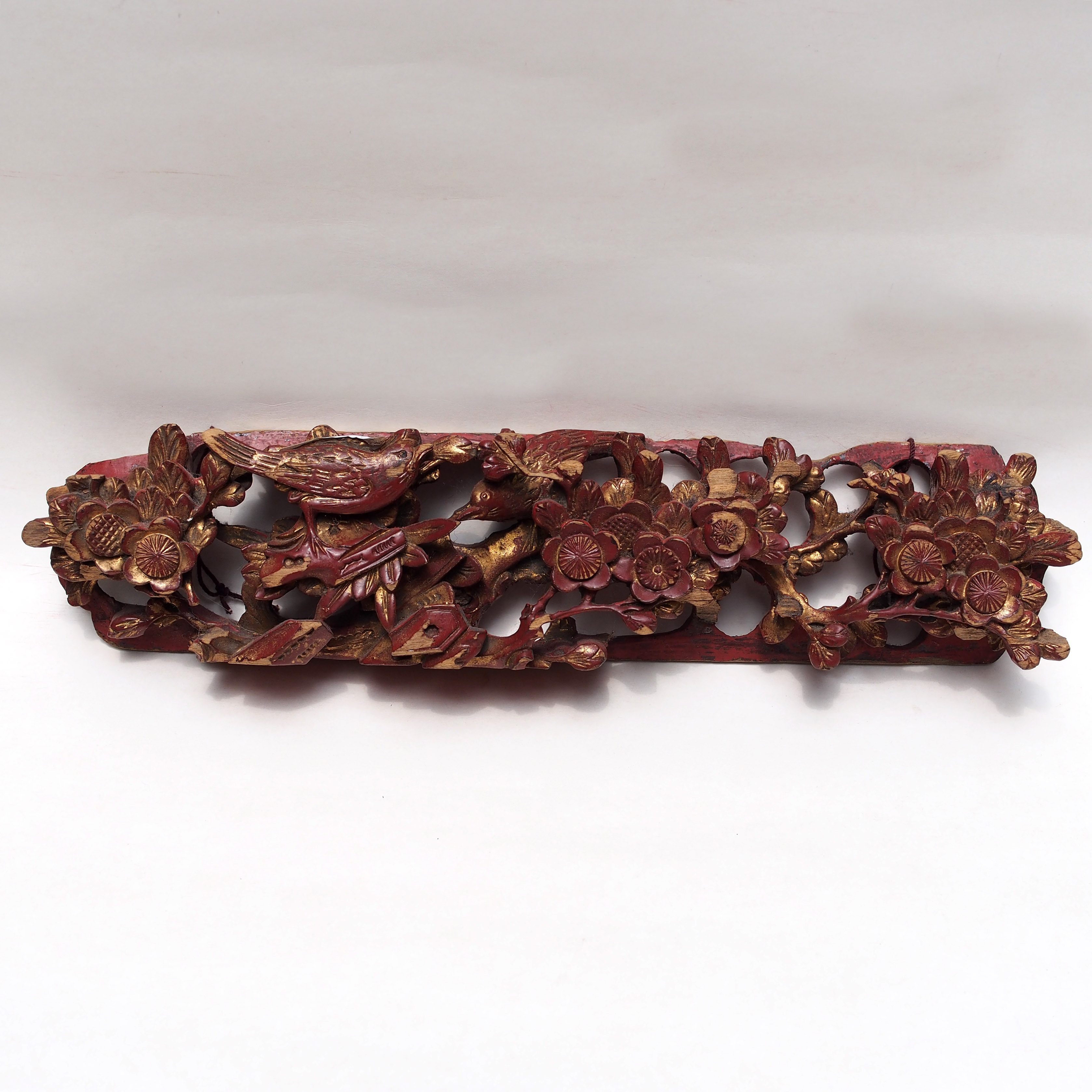
golden wood carvingL300xD45xH65mm, China

The composition of plum blossom and bird is a popular theme for Chinese crafts.

Not only it this a yearly event when the birds come to party and feast when the plum blossom, it also has a symbolic meaning.  A play on the phase 喜上眉梢 (xi shang mei shao), one is so happy that joy is expressed when in the eye brow.  You might wonder what a facial express has to do with plum blossom and bird.  The bird is 喜鵲 pica pica (magpie), its climbing on the plum branch 喜上梅梢 (xi shang mei que) has the same pronunciation has this uncontrollable joy.