Archives for category: figurine

W600xH600, China

This is a shadow puppet from the province of Luo Shan.  The written history of shadow puppet in China dated back over 1000 years and spread all over the country, slowly each region has their own characteristic, in terms of the puppet, its control and of course the singing (as each area has a different dialect).  450 year ago in Ming dynasty shadow puppet theatre arrived Luo Shan from Luan Zhou.  Unlike the other region that uses donkey skin, Luo Shan’s puppets are with buffalo skin.  Each puppet are controlled by 3 bamboo rods and cast over a white cloth screen of 1.8x1m. The puppet theatre group would consist of 8 people (3 puppeteers), the puppet “cast” are huge (300 odd heads to match with 80 odd bodies), apart from characters there are also sets of  mountain, forest, vehicles, animals, furniture, etc!

W60xH120mm, China

These opera dolls have been a popular toy in Beijing since the Qing dynasty. The head and the base of the doll is made of clay, the structure with the stem of millet covered with a beautifully painted paper.  However, the most important construction of the dolls are the 2mm tall bristle at the bottom of the base.  They will be played on a bronze tea tray.  By tapping lightly on the tray, the figurines would move in a rhythmic fashion just as they would in the beijing opera.  Apart from being a toy, they are also used for performance, “bronze tea tray opera”; the required characters for the opera would be put on the tray, matched with real life opera singing.

W80xL250xH140mm, China

We have cowboys in China too and this is a very famous cowboy.  At the end of the Ming dynasty, a time when the capital was under the attack of revolts, the Qing army, the Ming  capital moved south to Nanjing.  The courageous General Zheng  led the Ming navy defended against the Qing at the north, deterred the pilots from the Netherlands and claimed back Taiwan.  Before his return from Taiwan the Qing army took over the ruling of China and Zheng died unsettled in Taiwan.  When Qing took over, the folks were still reminiscent of the previous dynasty, not knowing Zheng’s death was longing for his return to bring back the Ming empire.  At his hometown Fujian, as a discreet statement, the craftman made variation of sculpture with a cowboy on a screaming buffalo; the first Ming emperor Zhu was in fact the famous cowboy.  Now nearly 400 years on, this design has gained his own name.

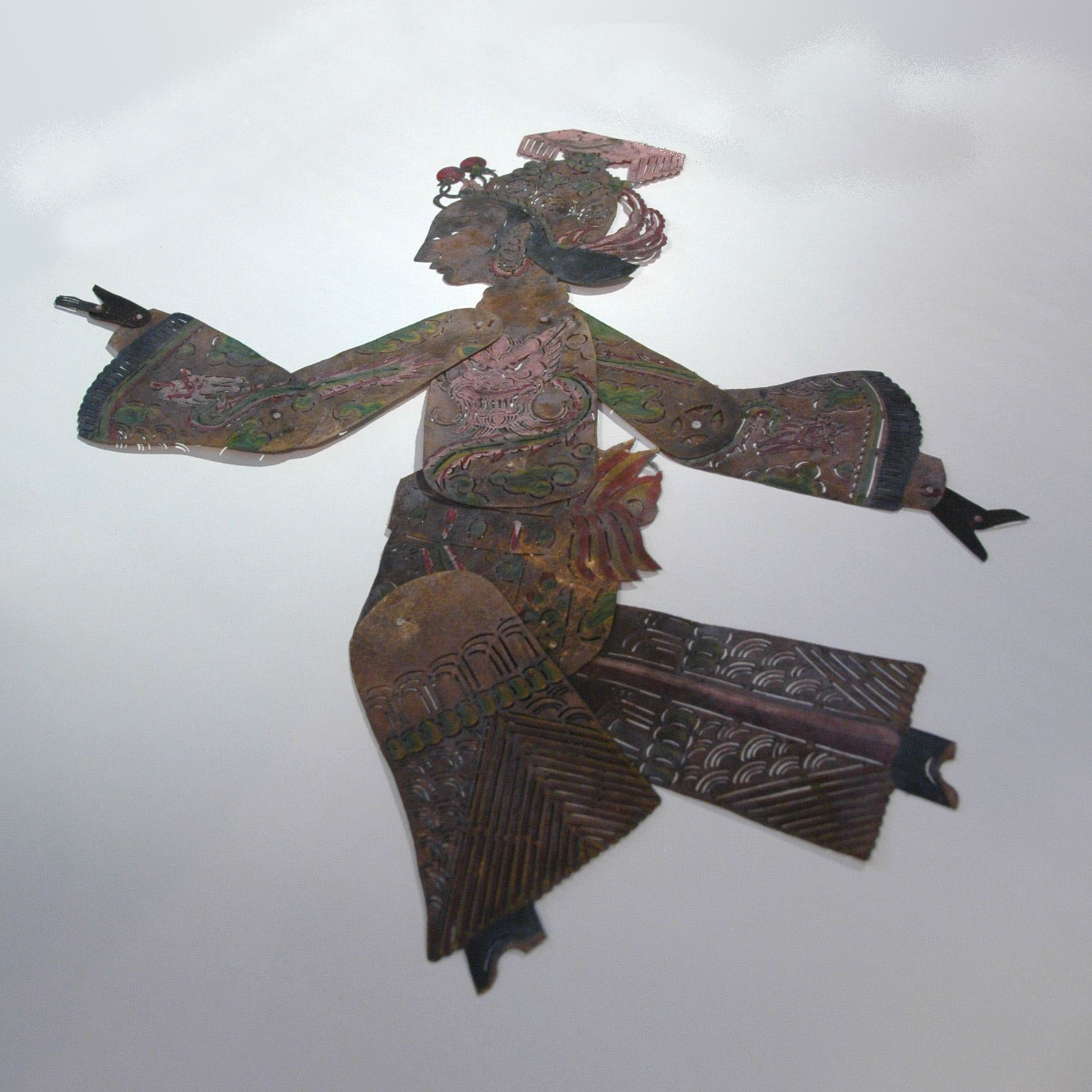
W250xH300mm, China

Before the arrival of cinema, television and the internet, shadow puppet was the “it” entertainment in China.  The puppet is placed next to the screen (a 1 sq m treated muslin)  with lighting from behind.  Like the theater, the puppet casts include the hero, heroine, masculine, villain and of course the clown.  Each puppet is controlled with 5 bamboo stick; the puppeteer is responsible for the control 4 puppets, singing, narration, dialogue and drums.  The shadow puppet is usually made of  donkey skin which give a more transparent effect.

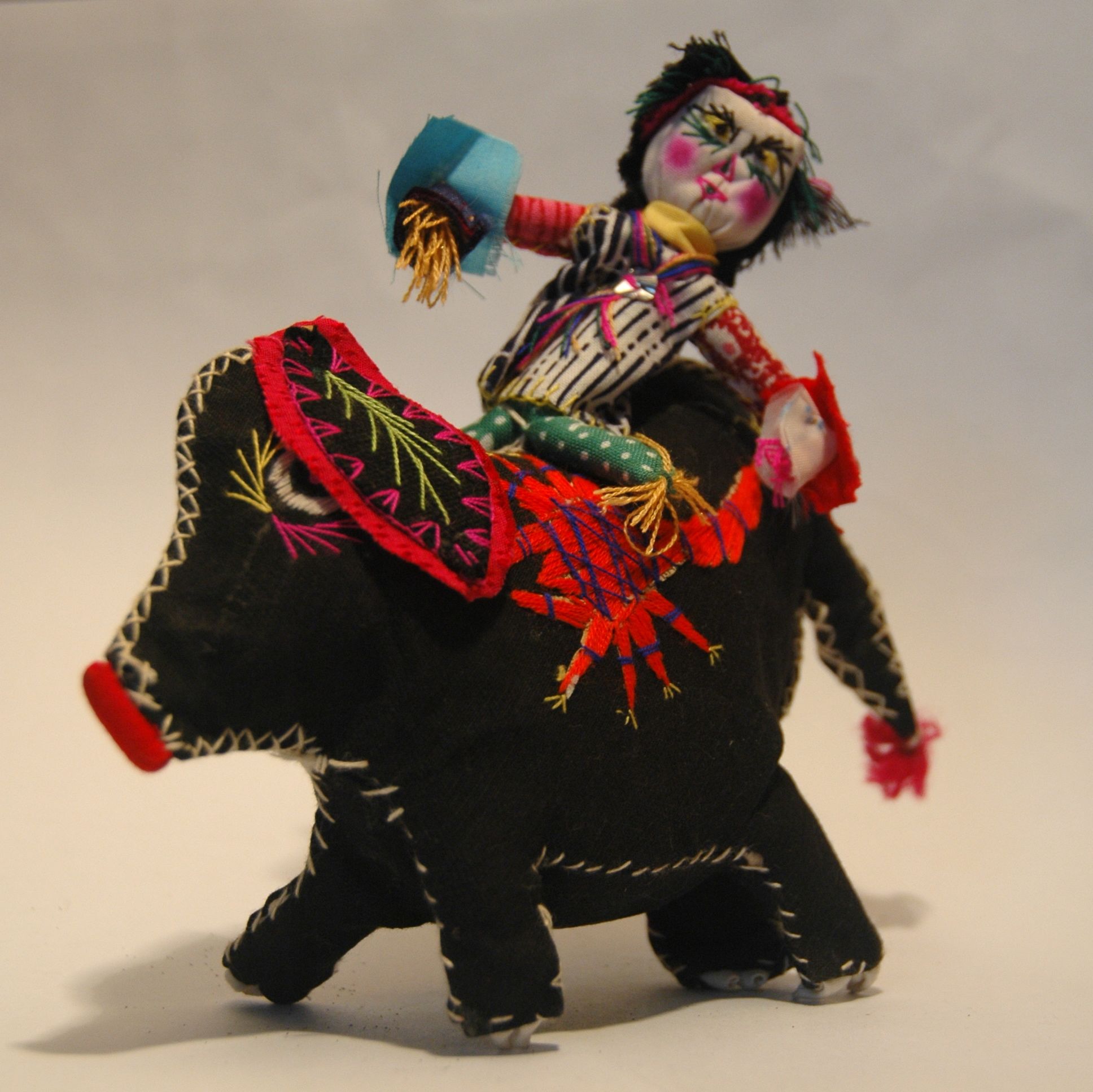
H150xL150xW50mm, China

Cloth toys are popular items made by mothers for their children in rural China.  They are made of everyday object; leftover cloth, cardboard, decorated with bold embroidery giving an animated life to the toy.  The cloth toy in this part of Shaan Xi area is noted for the head being flat and changing to a 3 dimensional body.

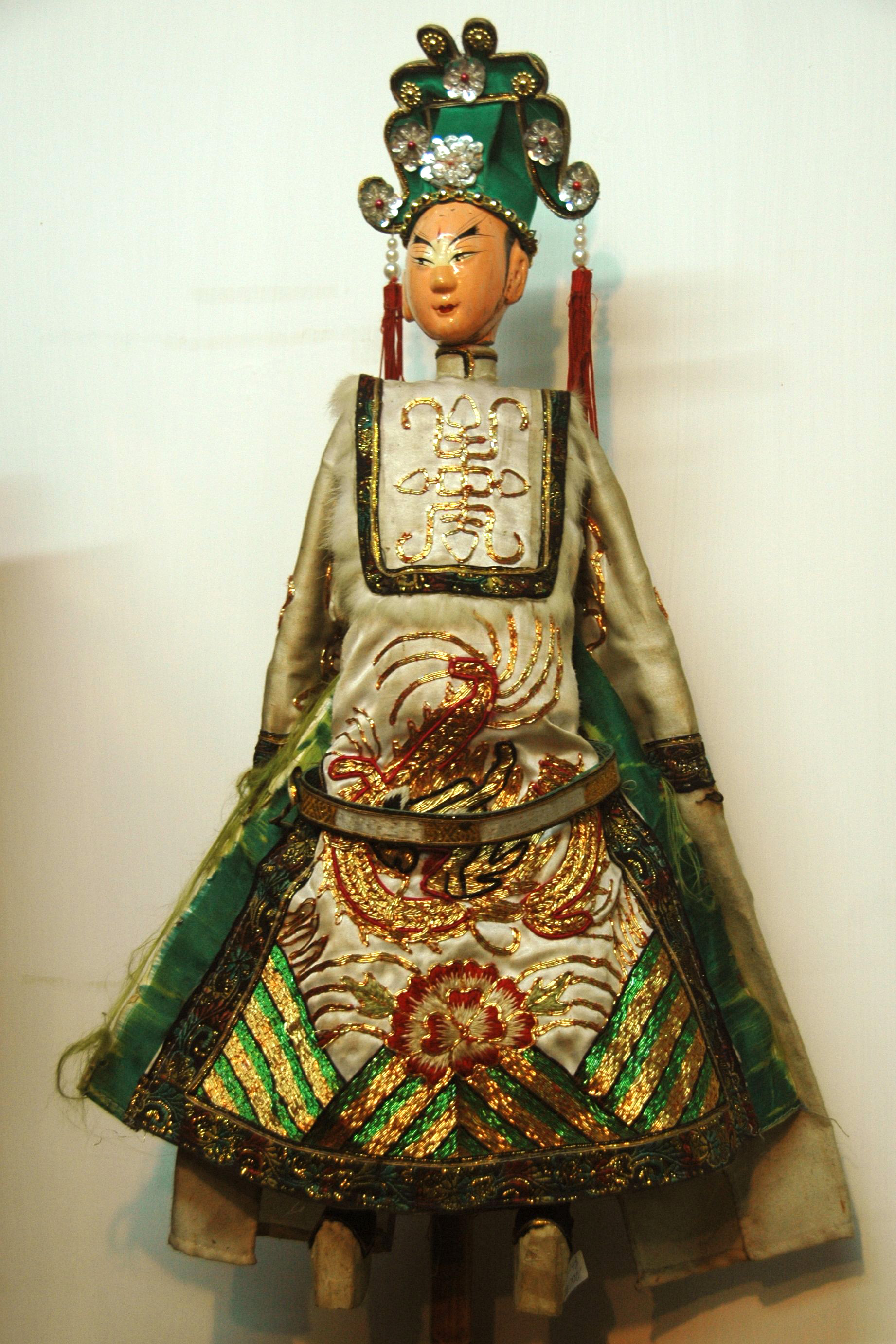
H500xW150mm, China (Chaozhou)

This is a Chaozhou wire puppet.  The head and the body are made by 3 separate specialist craftman, a pottery is charge of the clay head, an embroider is responsible for the costume and the puppet maker for the body, legs, hands and putting the puppet all together.  The body is made with a piece of local soft wood (Erythrina variegata) that has been treated by wetting and drying against cracking and snapping.  The clay head is painted over with the facial characteristic for the different character of the puppet show and these also go for the costume.

H100xW50xD60mm, China

Puppets originally are used as burial item made to replace human sacrificial burial.  In the Han dynasty theatrical art developed, puppet show was not only the first performance art of China, it was the leader of all theatrical art.  By Sung Dynasty, Quan Zhou was the cosmopolitan of its time; arts, trade, religion were at their peak, religious ceremony was held every 3-5 days, the witch craft associated puppet show flourished. There was a demand of high quality puppets, the carving works of the head that were in the beginning carried out by the Buddha statue craftman were later developed as specialised art.  This is a glove puppet of a monk, the eye and the mouth can be controlled separately and there is even a small tongue!

H250xW100xD150mm, Thailand

Please pray for those who are suffering by the flood in Thailand, the worst in 50 years, and that serenity will return soon.

Praying monk figurine; they are usually found in a pair at either side of the Buddha statue, both kneeling, one praying and the other one has his hands resting on the thighs.

H270xW40xL100mm, China

Since the Ming dynasty bamboo carving has been seen as a specialized art; the practitioners are literati who are master of calligraphy and stone carving, this together with the nature of the material bamboo (hollow internally with knots at intervals), bamboo carving  has combined painting and sculpture in one art form.  There are broadly two type of bamboo carving, utilitarian and decorative.  The utilitarian form mostly make use of the hollow of the bamboo shaft (e.g. a pen holder, wine cup, weight etc) and relief type engraving on the surface of the bamboo.  The decorative form are sculpture of figurines, birds, etc, the design would play on the solid and void of the material.  This carving is the early work of the famous artist Zhang De He of Zhe style.

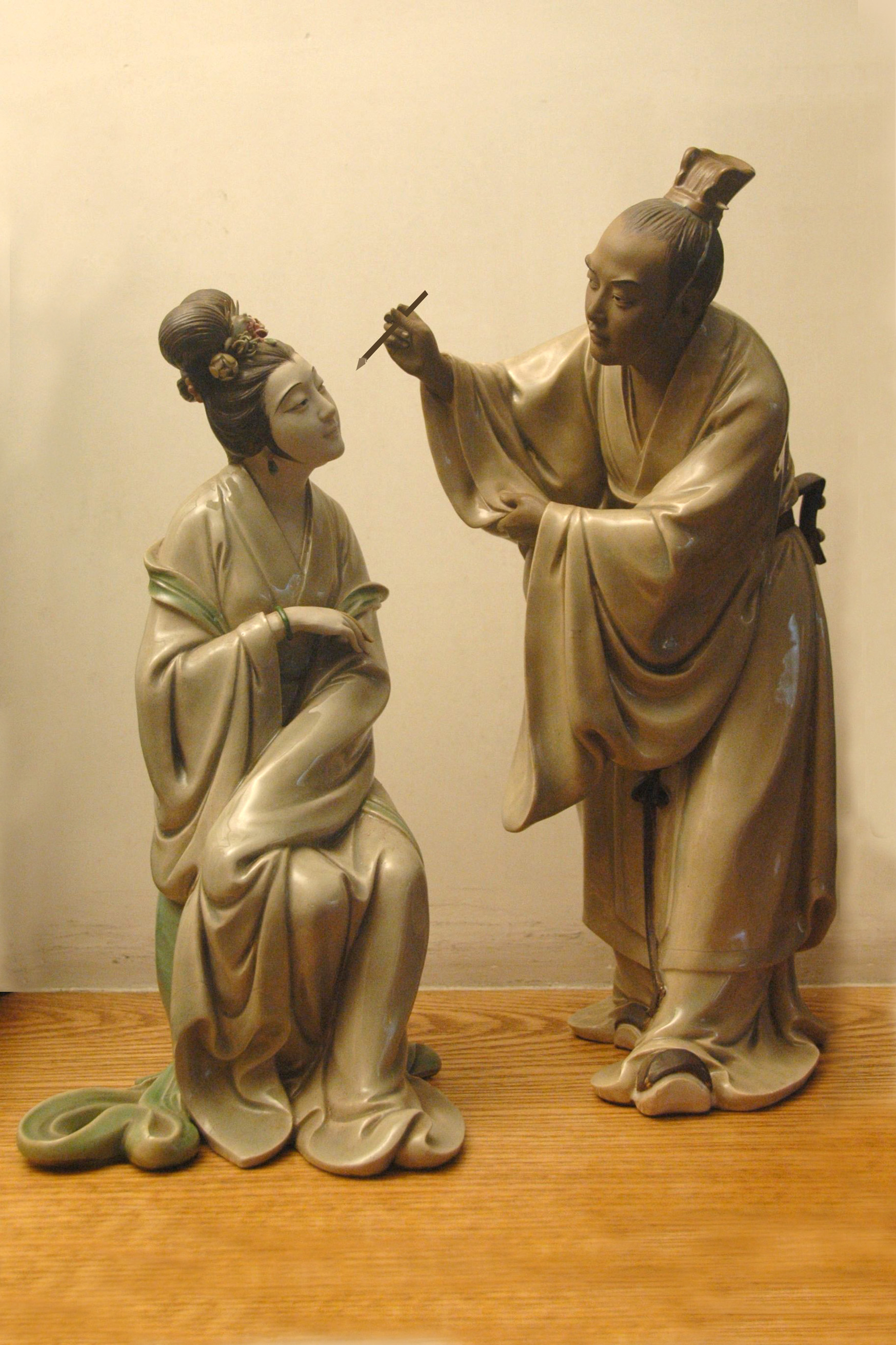
Man H400xW150mm, China

This is a story about Zhang Chang, a noble official in the Han Dynasty who kept the country at peace for many years.  Being faithful and out spoken, others officials were jealous and would find faults in him to report to the Emperor.  Zhang’s wife was beautiful, everyday Zhang would touch up her eyebrow before going to work.  His rivals reported this to the Emperor and when he was questioned, he answered “there are more ridiculous thing a married couple would do in the bedroom, please ask me only about my duty, what I do with my wife is only my business.”  Because of the nature of the story, it is a very popular subject for work of art.  The Shi Wan area is famous for its pottery; its beautiful colour glaze, the fine detail and the capture of the gestures.