Archives for category: bamboo

W100xD40xH110mm, China

This whiskey flask shaped cage is for keeping crickets.  Chinese have been keeping crickets since the Tang dynasty, however, very few of them as been kept as pet but rather as fighters.  Cricket has a life span of around 100 days, cricket match traditionally take place in autumn, it is said that the word “autumn” 秋 represented 2 crickets.  Cricket fight is banned in Hong Kong, so good to say that those raised here are only as pets for admiration.   This cage has 3 compartments, 2 small ones on the upper deck and 1 at the lower deck.  As each male cricket need to be  isolated to avoid conflicts, 3 can be raised in this single cage.  As in all the Chinese bamboo cage design,  if you look closely at a gate, one of the bars is shorter, this acts as a safety lock so that the gate cannot open accidental.

For a more natural cricket cage, see the entry gourd cricket cage.

 W110xL80xH50mm, China

This box is entirely made out of bamboo, even using the natural cross section of the bamboo to create this pattern.

W500xL600mm, China

Though paper is one of the 4 great invention of China, handmade paper is a dying art.  To earn a living from making paper is hard work; there are all together 72 steps!  This is only a rough idea what is has been done to make the paper.

First, in late spring young bamboo are collected from the forest, these 2 m long bamboo are then cut into 2 cm wide stripes.  These stripes are soaked in lime water for 2 to 3 months.  At the point, the bamboo would have turned yellowish, they are then rinsed and cleaned with water and the knots and the outer skin will be removed.  These stripes are then put in a 5 m long x 1 m wide wooden trough for stomping (just as grape stomping for wine).  Now we finally have the paste for paper making; the paste is put into a 2 m long by 1 m tall wooden trough and mixed with a glue solution.  A deckle with fine silk sieve mounted on a wooden frame is lowered into the paste and then taken out, after the water is drained away a thin layer of paste is left.  The paste sheet is flipped out on wooden board, silk sieve removed and we have a wet piece of paper.  These wet paper is piled up and water squeeze out under the wooden press.  Lastly, the paper are separated and posted on the drying room one by one.  These workshops are usually run by 10 people;  2 for the stripping of bamboo, 2 for stomping, 3 for sieving, 2 for drying and one for all the other bits and pieces.

W230xD110xH180mm, China

This is a bamboo case with all the parts; hinges, bolds, handles are made out of bamboo.  This brings back a lot of memories for me, as a child of a folkcraft shop owners this is the version of the Bond’s gadget briefcase I had.  Inside stored all my little treasures.

Dia110xH400mm, Japan

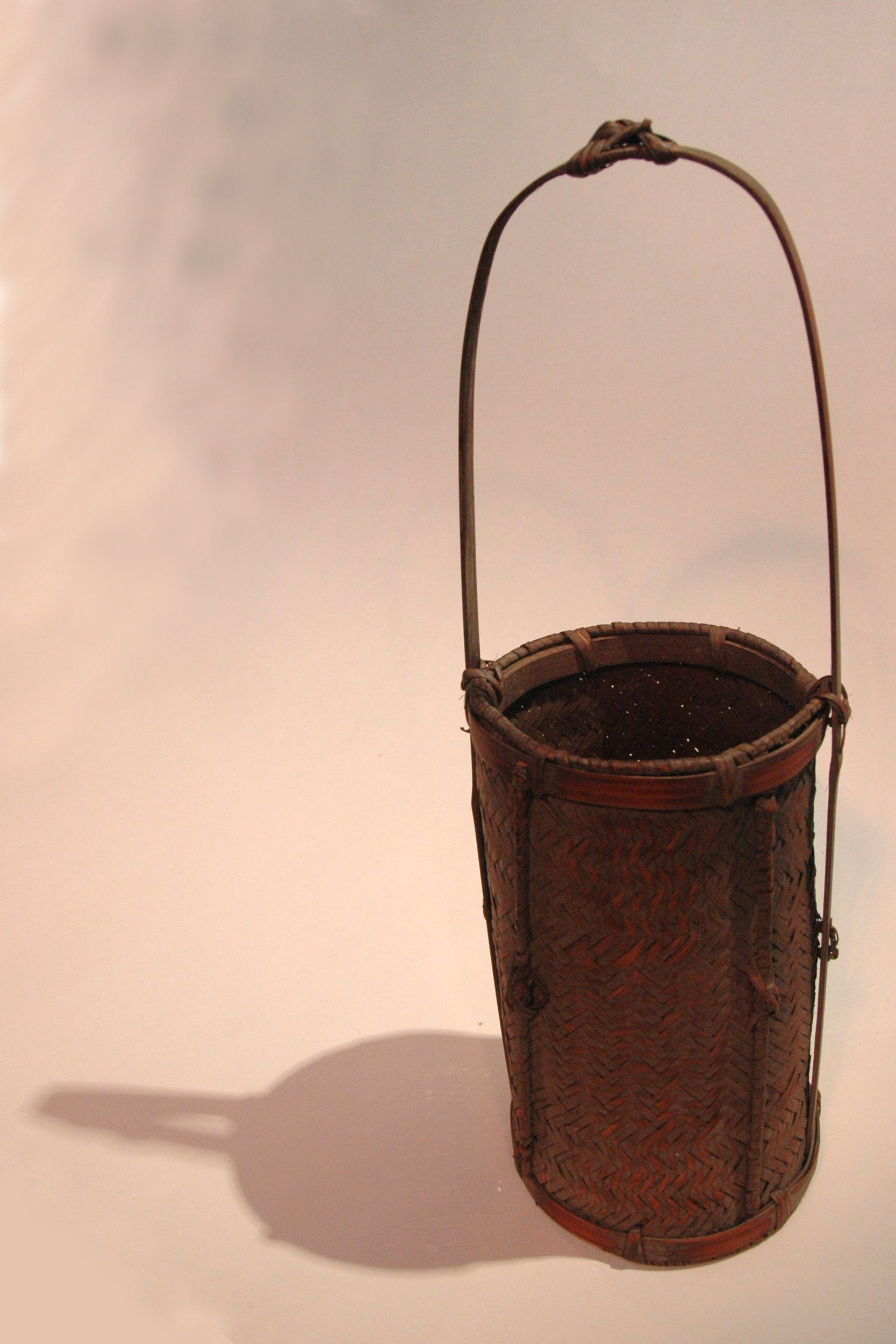
Bamboo as a material has been a very well utilised in Japan (and Asia) such that bamboo weaving became a specialized craft. Bamboo tree of 3-4 years old are cut, boiled to remove the oil and dried under the sun (there colour would turn from green to brown).  The bamboo is first split by a tool known as the Kikuwari (which looks a bit like the fruit cutter) dividing the bamboo stem into equal divisions.  The surface of the bamboo is then scrap off to allow the lacquer or other finishes to absorb.  To make the higo, each of the large section is split into half with the knife from the back side of the bamboo, the strip is peeled and then strip again to the desired width.  Finally, each strip is then rounded off on the 2 sides and the thickness evened, the higo is ready for weaving.  All these steps might sound simple but will take a very experience craftman to produce good quality higo, just for using the kikuwari to split straight down would take at least 3 years of practice.  This is a simple bamboo ikebana basket for Japanese flower decoration.

L500mm, China

This is a snake toy made of section of small bamboo, with each section held together by a small metal rod.  Holding on to the tail section, it will become animated and move like a real snake ready to attack!

H270xW40xL100mm, China

Since the Ming dynasty bamboo carving has been seen as a specialized art; the practitioners are literati who are master of calligraphy and stone carving, this together with the nature of the material bamboo (hollow internally with knots at intervals), bamboo carving  has combined painting and sculpture in one art form.  There are broadly two type of bamboo carving, utilitarian and decorative.  The utilitarian form mostly make use of the hollow of the bamboo shaft (e.g. a pen holder, wine cup, weight etc) and relief type engraving on the surface of the bamboo.  The decorative form are sculpture of figurines, birds, etc, the design would play on the solid and void of the material.  This carving is the early work of the famous artist Zhang De He of Zhe style.

(L)L700xW550mm (S)L370xW260mm, Japan

This is a Japanese fan, uchiwa, it is constructed from a single piece of bamboo.  The bottom part of the bamboo forms the handle while the top part is split into many equal splinters which are splayed out radially to create the frame of the fan, paper is then pasted on top and varnished for water protection.  For the large uchiwa, thick cotton string is used to tie together the bamboo stems to reinforce the fan structure.  The uchiwa are believed to be originated from China, during the Tong dynasty they were introduced to Japan and also became a popular accessories for the aristocracy and ladies.  The pattern on the paper are refined and elaborated.  Apart from daily use for cooling, the uchiwa is also used in ceremonies, dances and gifts.

Dia250xH450, China

This is a birdcage both for raising a bird at home and for “walking” the bird.  The Chinese believed that even for home kept birds, they should be meeting with their birdy friends to share their songs.  In the south, this gathering would happen daily at the teahouse, usually in the morning over dim sum where the owners should chat with their friends and the birds theirs.

There are also the attachment to go with it; bird feed bowl,  bird feeding cage.

W150xH150xD100mm, China

Chinese root carving is a broad term for carving that includes root, bark, knots and bamboo roots.  The essence of these type of carving focuses on the natural growth of the material as well as abnormal growth.  Hence, the major part of the artwork is translation from nature and with a small enhancement in detail.  This type of carving is really material based, the knot, the grain, colours, etc.  This particular one is a bamboo root carving of a helmet and a surrendered monster.